Professor Forte’s Publishes Book Chapter on “Conscience and Republican Government”

Professor David Forte has authored a chapter, titled Conscience and Republican Government, in the just-published book, Contemporary Challenges to Conscience, Aleksander Stepkowski, ed., published by Peter Lang.  The book includes contributions from a variety of authors on the challenge of reconciling the state’s claim to uniform application of the law with the individual’s claim to the dictates of conscience.

Professor Forte’s chapter examines the various models, in American political history, for managing this dilemma between absolute state sovereignty and individual conscience.  He contends that “there is no single formula of governance that can guarantee the right of conscience,” explaining that the American tradition contains a number of different mechanisms for appropriately protecting individual conscience:  (1) infusing the political sovereign with the principles of natural law; (2) limiting political power through divisions of authority; (3) creating regimes of individual rights; and (4) leaving religion a sphere of self-governing independence separate from the sovereign.

“In the end,” Professor Forte concludes, “the struggle for rights of conscience is a struggle to affirm the nature of the human person, his reason, and his liberty.”

Dean Fisher Discusses Mueller Testimony on WKYC Channel 3

Dean Lee Fisher was a featured guest on WKYC Channel 3’s evening news broadcast.  Dean Fisher, along with Cuyahoga County Republican Party Chair Rob Frost, discussed the testimony of Special Counsel Robert Mueller.  Dean Fisher argued that the key take-aways from Mueller’s testimony are that Russia attempted to influence the 2016 presidential election in favor of President Trump, and that Mueller’s report does not exonerate President Trump on possible obstruction of justice.  He observed that throughout the hearing, both Republicans and Democrats simply emphasized the parts of the Mueller report they already agreed with, and that it was unlikely that Mueller’s testimony changed anyone’s mind.

The segment can be seen here.

Professor Forte Featured in Wall Street Journal on Pro-Life Movement

On July 17, Professor David Forte was featured in a front-page Wall Street Journal article on emerging divisions within the pro-life movement.  While pro-life activists have long sought to steadily impose new limitations on Roe v. Wade, a new group of activists have pressed for a more aggressive legislative strategy with the goal of overturning Roe.

The article discusses Professor Forte’s role in the pro-life movement’s development of “heartbeat” bills.  The article explains that Professor Forte “seized on medical research indicating cardiac activity was a key predictor of infant survival. He wrote an analysis that framed legislation not as a blunt attack on Roe, but as flowing out of the doctrine of Roe and later Supreme Court cases.”  Professor Forte advanced the argument to state legislators “that the viability standard was too ambiguous and subject to varying opinions,” and instead proposed that “detection of cardiac activity is a clearer, more precise dividing line, and would offer conservative Supreme Court justices an attractive alternative.”

The article is available to subscribers here.

Sagers Speaks With International Press on Big-Tech Antitrust Investigations; Interviews with Corporate Counsel on New Book

Chris Sagers, the James A. Thomas Professor of Law, spoke with several news outlets about this week’s announcement of a new Justice Department investigation of potential antitrust violations by the big tech platforms, and among them were prominent outlets overseas.  He spoke with Agence France-Presse for a story that was carried in various international publications, and appeared on a morning business affairs program on BFM 89.9, a radio station in Kuala Lampur, Malaysia.
Sagers also spoke with Corporate Counsel, a widely read publication of American Lawyer Media, about his new book “United States v. Apple: Competition in America,” which will be published in September by Harvard University Press.

Professor Lewis Elected to American Law Institute

Browne Lewis, the Leon and Gloria Plevin Professor of Law, has been elected to membership in the American Law Institute (ALI).  The ALI is the leading independent organization in the United States producing scholarly work to clarify, modernize, and otherwise improve the law.  The ALI drafts and publishes Restatements of the Law, Model Codes, and Principles of Law, which are extremely influential in the courts and legislatures, as well as in legal scholarship and education.  ALI members are elected on the basis of professional achievement and demonstrated interest in improving the law.

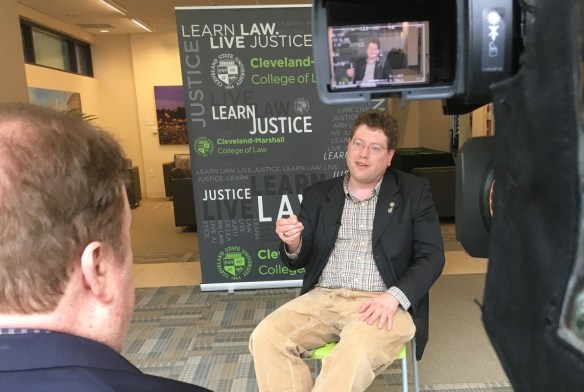
Fox 8 interviews Professor Plecnik on public records law and the impact of Sheil v. Horton

Plecnik Fox 8On June 27, 2019, Fox 8 broadcast its interview with Professor Plecnik on public records law and the impact of Sheil v. Horton.  Anchor and I-Team Reporter Bill Sheil, the named plaintiff in Sheil vs. Horton, asked Professor Plecnik about his case and the problem of government agencies using nonprofits as conduits for public money to avoid scrutiny and public records requests under the Ohio Sunshine Laws.

Reporter Sheil and Fox 8 brought their case using the new, expedited procedure to contest denials of public records requests in the Ohio Court of Claims, which was voted into law by the Ohio General Assembly in 2016.

From the interview:  “Public policy expert John Plecnik says the fact that the case began with the new process that goes through the Court of Claims is significant.  ‘So this is really new ground that we’re breaking, and I think it’s positive from the perspective of disclosure and taxpayers that the first major decision says err on the side of disclosure.’”

In Sheil v. Horton, Reporter Bill Sheil and Fox 8 sued Cuyahoga County Community College, better known locally as Tri-C, for disclosure of how much it paid Academy Award winning actress Octavia Spencer to speak at a luncheon in 2017.  Tri-C denied Fox 8’s public records request on the grounds that its affiliated nonprofit—the Tri-C Foundation—actually contracted with and paid Ms. Spencer.  Even though Tri-C is admittedly a public entity as a state-supported community college, it argued that the Tri-C Foundation is a private, nonprofit organization that is not subject to public records requests.  In a unanimous opinion authored by Judge Patricia Ann Blackmon, the 8th Appellate District Court of Appeals of Ohio ruled in favor of Fox 8 and required disclosure.

In ruling for Fox 8, the Court of Appeals applied the “functional-equivalency test” first articulated by the Ohio Supreme Court in its 2006 decision of Oriana House v. Montgomery.  To quote the Ohio Supreme Court, “[u]nder this test, the  court  must  analyze  all  pertinent  factors,  including  (1)  whether  the  entity  performs  a  governmental  function,  (2)  the  level  of  government  funding,  (3)  the  extent  of  government  involvement  or  regulation,  and  (4)  whether  the  entity  was  created by the government or to avoid the requirements of the Public Records Act.”

Professor Plecnik closed his interview with Fox 8 expressing his hope that recent case law in favor of disclosure will reduce the need for litigation:  “If we can build off of Sheil v. Horton and build a culture of disclosure, it won’t even be necessary for taxpayers to bring these lawsuits.”

Professor Forte addresses Supreme Court of Poland

On June 14, at the invitation of dr. hab. Joanna Lemańaska, President of the Supreme Audit Chamber and Public Affairs Department of the Supreme Court of Poland, Professor David Forte addressed justices and guests of the Supreme Court of Poland on the topic: “The Judge and the Rule of Law.”

Professor Forte is serving as the Distinguished Fulbright Chair for the Faculty of Law at the University of Warsaw, Poland.


Robertson interviewed by The Allegheny Front (public radio) regarding Ohio and Pennsylvania regulation of oil and gas industry

Professor Heidi Gorovitz Robertson was interviewed by public radio reporter and host Kara Holsopple for The Allegheny Front regarding some differences in the ways Ohio and Pennsylvania regulate the oil and gas industry and, in particular, the hydraulic fracturing technology. The interview, titled  “How Ohio Compares to Pennsylvania for Oversignt of Gas Industry” is available here:

https://www.alleghenyfront.org/how-ohio-compares-to-pennsylvania-for-oversight-of-gas-industry/

This interview and an earlier interview with report Julie Grant were also used as background for another story in the same series.  The earlier story, “Some Ohio Citizens Who Complained about Oil and Gas Feel ‘Abandoned’ by the State,” aired on public radio in Pittsburgh and will be broadcast more broadly in the region.  It is one of a five-part series entitled “Who’s listening?” examining claims made by Ohio residents, and how state regulators have responded.  You may listen here:

https://www.alleghenyfront.org/some-ohio-citizens-who-complained-about-oil-and-gas-feel-abandoned-by-the-state/

Dean Fisher Op-Ed highlights importance of auto industry for Ohio

Ford Motor Company's Cleveland Engine Plant No. 1 in Brook Park, Ohio, employs about 1,500 making 3.5-liter EcoBoost and 3.7-liter Duratech engines. (Beth Mlady/Special to cleveland.com, File, 2017)

Dean Lee Fisher published an op-ed on Cleveland.com emphasizing the importance of the auto industry to Ohio’s economy, jobs, and tax base.  He cautions that changes in technology and the global economy, not to mention steel and aluminum tariffs, pose dangers to the auto industry, and that Ohio must work to ensure the continued vitality of this critical industry:  “having a false sense of security would be a mistake.”

Dean Fisher notes that the auto industry has a particular strong “multiplier effect” on jobs, citing research showing that “every auto manufacturing job creates seven additional jobs.”   He concludes that “[a]ll stakeholders, including the automakers, their labor partners, policymakers and economic development leaders, should continue to collaborate to ensure these plants continue to drive job growth in our state.”

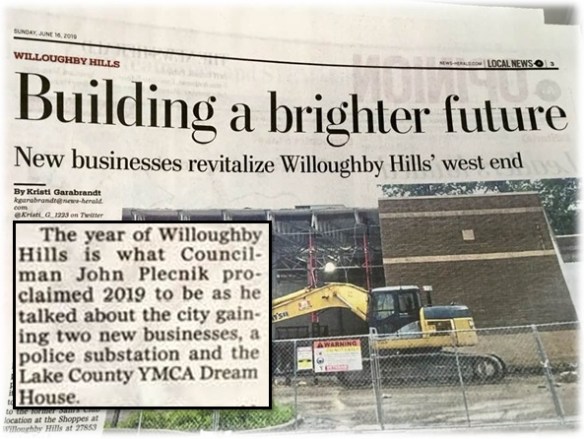
Professor Plecnik interviewed by The News-Herald on his successful efforts to use tax abatements for economic development in Willoughby Hills

News Herald economic dev 2019 v2

On June 15, 2019, The News-Herald published an interview with Professor John Plecnik, who also serves as Vice President of Council & Councilman-at-Large for the City of Willoughby Hills, on his successful efforts to economically redevelop the City’s business district and build a brighter future for the west end of Lake County by using his expertise in tax law.  “[T]he major economic development of bringing Produce Packaging to Willoughby Hills along with the police substation, Aldi and last year, Hospice of the Western Reserve coming to Willoughby Hills does represent a major improvement in the economic climate in the city,” Professor Plecnik told The News-Herald.  “I think it’s largely the result of an aggressive strategy to recruit businesses and jobs through tax abatement which is something that Councilwoman Laura Pizmoht and I as the tax and economic development experts on council have taken the lead on and the mayor and Council President Nancy Fellows have been incredibly helpful in that process and supportive of what we have done.”

Professor Plecnik’s teaching and scholarship focuses on the intersection of taxation and public policy, and his work has been cited as authority by the Supreme Court of the United States.  You can review the tax abatement or “Incentive Grant Agreement” (which is a public record) that Professor Plecnik negotiated and drafted to bring Produce Packaging and over 300 jobs to Willoughby Hills here:

http://www.willoughbyhills-oh.gov/Ordinance.2018-50-Exhibit%20A.pdf