Professor Kalir’s Paper on Human Dignity Selected for Presentation at the Inaugural “Faith, Values, and the Rule of Law: An Interdisciplinary Conference”

On February 4-5, Seton Hall Law School will host its first-ever “Faith, Values, and the Rule of Law: An Interdisciplinary Conference.” The conference will examine “how the world’s greatest religious, theological, and philosophical traditions have all contributed to the understanding of justice and human dignity that underscore modern rule of law principles,” bringing together “scholars in law, theology, religious studies, philosophy, political science, international affairs, history, literature, ethics, and related disciplines.” 

Professor Kalir’s paper, “Jewish Human Dignity:  Equality Before God & Men,” was selected for presentation at the Conference. The paper traces the notion of “K’vod Ha’Adam” – human dignity – in the Jewish bible as one of the main origins of the modern notion of equality. It further claims that understanding equality in such terms should trigger a rebuttable presumption of “leveling up” of equality-violation remedies, an issue that has long been portrayed as “one of the most vexing issues of constitutional equality.”
Professor Laser Publishes Essay on Legal Empiricism

Christa Laser published the essay Ten Tips for Legal Empiricists in the Northwestern Journal of Technology and Intellectual Property. The essay, co-edited by Professor Laser and Professor Jordana Goodman, includes contributions from a range of leading empirical scholars on advice for empirical legal research.

In addition to Professor Laser and Professor Goodman, contributors to the essay include Mark Lemley, Lisa Larrimore Ouellette, Michael Frakes, Melissa Wasserman, Saurabh Vishnubhakat, Janet Frelich, Jennica Silbey, David Schwartz, and Neel Sukhatme.

The citation is Jordana Goodman and Christa Laser, Tep Tips for Legal Empericists, 23 N.W. J. Tech. & Intell. Prop. 227 (2025),

Professor Sterio Participates in Book Roundtable at Temple Law School

Professor Milena Sterio presented at a book roundtable at Temple University’s Beasley School of Law on December 11 in Philadelphia.  The book roundtable centered around Professor Harold Hongju Koh’s new book, The National Security Constitution in the 21st Century. Professor Koh, Yale Law School, is former Legal Advisor to the U.S. State Department and one of the most prominent scholars of international law worldwide. 

Professor Sterio’s remarks, on the topic of “Koh’s Mirror Approach as Restraint on Presidential Power in Matters of National Security,” focused on Professor Koh’s proposal, as described in his book, to require the same degree of congressional involvement when it comes to treaty withdrawal or exit as was required for joining the same treaty.  Professor Sterio’s remarks will be published in the form of a law review article by the Temple Journal of International and Comparative Law in 2026.

Professor Sterio Participates in International Criminal Court’s Assembly in The Hague, Netherlands

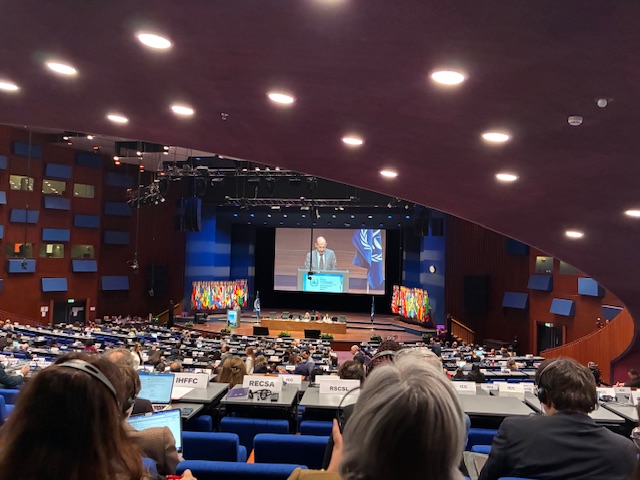
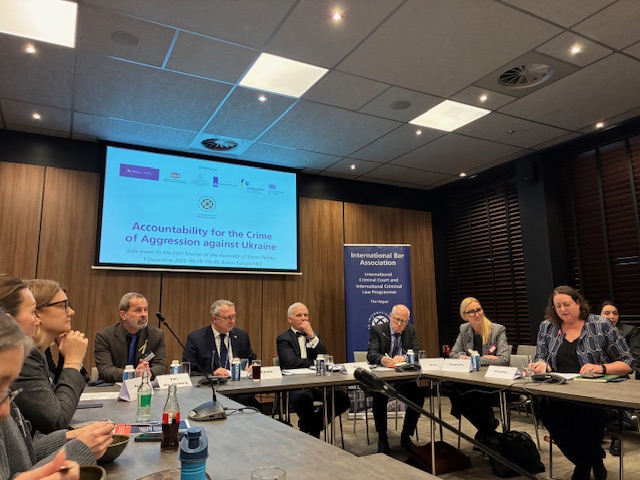
Professor Milena Sterio participated in the International Criminal Court’s Assembly of States Parties in The Hague, Netherlands, from December 1-5.  Professor Sterio participated as a delegate of the Public International Law and Policy Group, a Washington D.C.-based NGO (the ICC’s Assembly of States Parties is open to states and their delegates, as well as accredited NGO delegates). 

During the Assembly, Professor Sterio presented on a panel on the topic of “Practical Measures to Protect the International Criminal Court.”  Her remarks focused on the recent U.S. sanctions against three prosecutors as well as six judges at the ICC.  

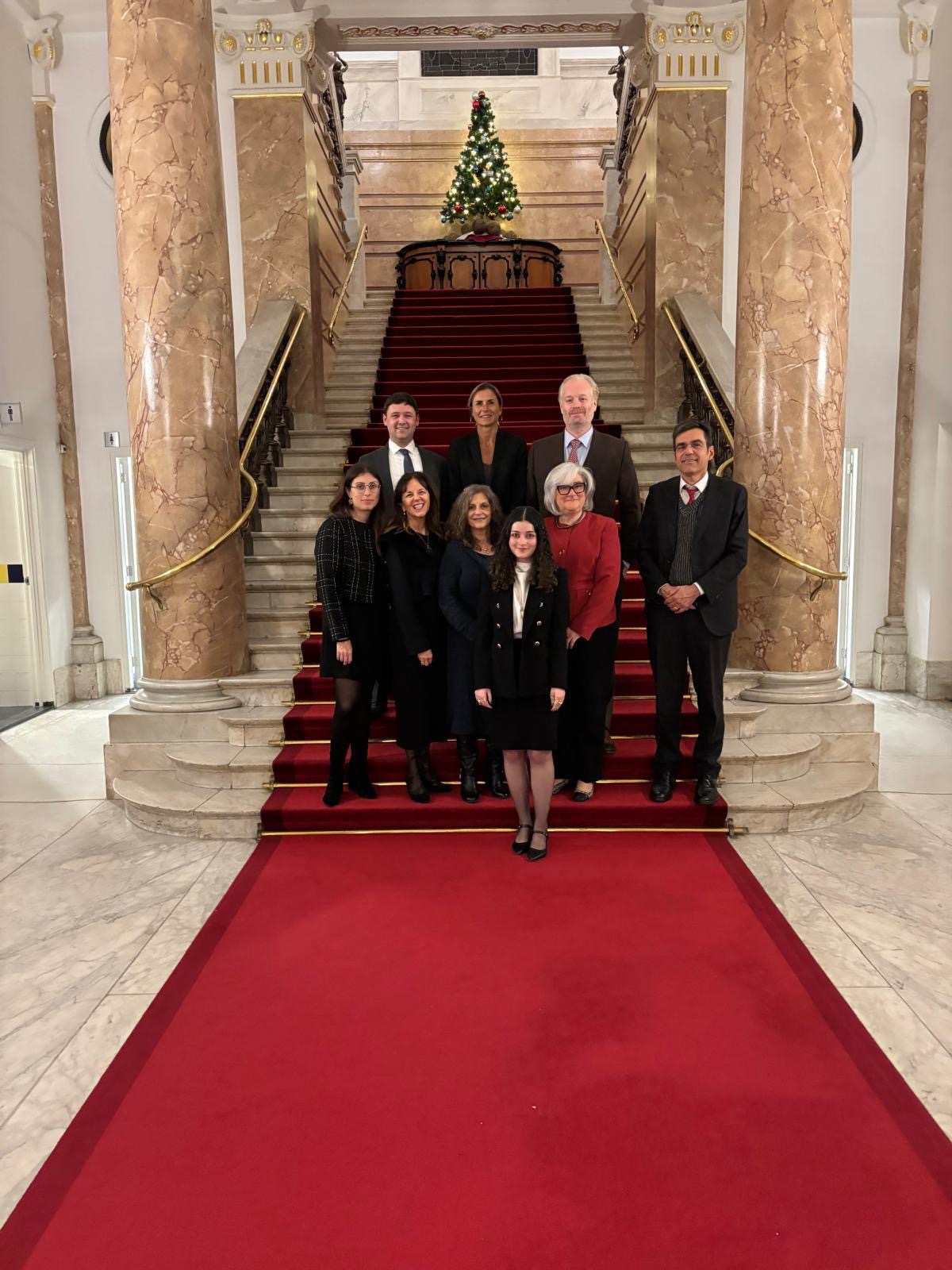
Professor Sterio (top center) with other members of the Crimes Against Humanity Study Group at the American Branch of the International Law Association.

Professor Witmer-Rich Comments on Hospital Detention Policy

Professor Jonathan Witmer-Rich was quoted in an article by Signal Cleveland, titled “He brought a gunshot victim to the Cleveland Clinic. Hospital police cuffed and detained him.” The article tells the story of Ibrahim Alim, who was detained by the Cleveland Clinic police when Alim dropped off a friend who had suffered a gunshot wound. The police also seized Alim’s car.

The article reports that the Cleveland Clinic has a policy directing police to detain any person who drops off a gunshot wound victim, without regard to the circumstances of the case.

Professor Witmer-Rich explained that this policy likely violates the Fourth Amendment:

To legally detain a person and their vehicle, police must reasonably suspect they are involved in criminal activity, said Jonathan Witmer-Rich, co-director of Cleveland State University’s Criminal Justice Center. Police officers have to assess each individual on a case-by-case basis, he added, looking for specific facts that show the person is involved in criminal activity.

But the Cleveland Clinic Police Department’s gunshot wound policy does not mention the standard of reasonable suspicion. As written, Witmer-Rich said it very likely violates the Fourth Amendment.

“The problem here is that this is a blanket policy,” Witmer-Rich said. “… And so a blanket policy that has you seize the car and the person every single time, I think, is not legitimate from a Fourth Amendment perspective.”

Professor Sterio Participates in Talking Foreign Policy Radio Show 

Professor Milena Sterio participated in another episode of Talking Foreign Policy, a quarterly radio show and podcast hosted by Professor Michael Scharf, Case Western Reserve University School of Law.  The program aired on Monday, December 2, and is available at the Ideastream Public Media website to listen to anytime at: Do US strikes against Venezuelan ships violate international law? | Talking Foreign Policy | Ideastream Public Media

In addition to Professor Sterio, panelists included Professor Harold Koh, Yale Law School and Former Legal Advisor to the State Department; Professor Rebecca Ingber, Cardozo Law School, and Dr Gregory Noone, Roger Williams Law School and Retired U.S. Navy Captain.

The episode focused on the legality of recent U.S. strikes against alleged narco-trafficking vessels originating from Venezuela and Colombia. 

Professor Kim’s Article on Functional Parenthood Featured on Jotwell

A forthcoming law review article by Professor Rama Kim was featured in a review in Jotwell. Jotwell is an online journal edited by a group of legal scholars that provides a forum to “identify, celebrate, and discuss the best new scholarship relevant to the law.”

The review, written by Georgetown Law Professor and family law expert Philomila Tsoukala, examines Professor Kim’s forthcoming articleParents, Kin, and the State: Family and Households Between Functional Parenthood and Child Protection. The article engages with the ongoing debate in family law surrounding the legal recognition of “functional parenthood,” or informal caregiving relationships that resemble legal parenthood.

While the recognition of functional parenthood is often viewed as an unqualified normative good in family law literature, Professor Kim’s article challenges this assumption. Drawing on an in-depth case study of Kentucky law, it examines how such legal recognition can operate for families susceptible to intervention by child protection agencies. As Professor Tsoukala notes, the article “suggests that the costs of this model are real and uneven,” and that “functional parenthood can burden parent–child relationships in poor and racialized communities.”

Professor Tsoukala calls the work an “important contribution” that “resists easy resolutions.” She writes that Kim’s “core claim is not that functional recognition is always wrong, but rather that its use in child-protection contexts brings distributional consequences that much of the reform literature has not fully considered.”

The review concludes: “In this important contribution, Kim reminds us that the future of family justice depends not only on recognizing care, but on deciding whose care counts and on what terms.”

Professor Kim’s forthcoming article is: Rama Hyeweon Kim, Parents, Kin, and the State: Family and Households Between Functional Parenthood and Child Protection, 33 Geo. J. on Poverty L. & Pol’y ___ (forthcoming, 2025).

Professor Hoffman Publishes on Social Isolation and Health

Professor Laura Hoffman has published an article titled “Putting the ‘Social’ into Social Determinants of Health: Why Policymaking for Improving Health Must Tackle Social Isolation and Loneliness,” in the Oklahoma Law Review.

The article “explores what is known about loneliness and social isolation in the United States and examines how law and policy can play a role in being part of reducing their impact on health.” In the piece, Professor Hoffman conducts “an examination of a sample of current legislative efforts to put loneliness and social isolation at the forefront now given the significant influence on health.”

She articulates a set of policy recommendations, arguing that “it is no longer possible for policymakers to neglect the ‘social’ aspect” of social determinants of health.

The article citation is Laura C. Hoffman, Putting the “Social” into Social Determinants of Health: Why Policymaking for Improving Health Must Tackle Social Isolation and Loneliness, 78 Okla. L. Rev. 97 (2025), https://digitalcommons.law.ou.edu/olr/vol78/iss1/4.

Professors Khan and Kalir Present at Advanced Appellate Advocacy Seminar

On Friday, November 21, CSU Law School hosted a day-long seminar on Advanced Appellate Advocacy in partnership with the Eighth District Court of Appeals. The seminar featured Justices, Judges, court staff, and practitioners who shared their experiences and expertise on appellate practice.

Two CSU Law faculty members also presented at the event. Professor Methab Khan presented on a panel titled “Generative AI 101 for courts: Hallucinations, Deepfakes, and the Record.”  Professor Doron Kalir presented on “The Art of Persuasion – How to Write an Appellate Brief.” 

The seminar was extremely well-received, and the MCR was full to near capacity. 

Professor Sterio Authors Book Review for Lawfare Blog

Professor Milena Sterio published a book review titled “The ‘End of Immunity’ for Leaders who Commit International Crimes?” on Lawfare Blog.  Lawfare is one of the most prestigious blogs in international law; book reviews are authored by expert invitation.  

Professor Sterio reviewed former International Criminal Court Judge Chile Eboe-Osuji’s book,  “The End of Immunity: Holding World Leaders Accountable for Aggression, Genocide, War Crimes, and Crimes Against Humanity” (Prometheus, 2024).  Judge Eboe-Osuji’s book espouses the view that customary international law rejects the principle of personal immunity before international criminal courts for sitting political and military leaders who commit atrocity crimes.  This view, which Judge Eboe-Osuji had adopted and advanced as an ICC judge, is shared by some scholars but rejected by others who argue that sitting heads-of-state waive immunity only if they are judged before an international tribunal whose jurisdiction their respective states have agreed to.  Judge Eboe-Osuji’s book addresses an important scholarly as well as practical topic.  It also provides a comprehensive historical analysis of various international negotiations, agreements, and other instruments as proof, according to Judge Eboe-Osuji, that customary law rejects personal immunity as a bar to prosecution of atrocity crimes before an international court.  

According to Professor Sterio’s review, “The strengths of ‘The End of Immunity’ lie in its elegant language, its thorough recounting of historical developments regarding immunity, and its passionate call to action for accountability for heads of state who commit atrocity crimes. It thus reflects Judge Eboe-Osuji’s long-standing quest to establish accountability for high-ranking officials and represents a kind of intellectual culmination of his career. In Eboe-Osuji’s words, “[a]ny argument for immunity of heads of state is effectively a protest against the judicial process[.]”