Professor Sterio Presents in Spain, Poland, and the Netherlands

Professor Milena Sterio presented at the European Society of International Law Annual Conference in Malaga, Spain, on September 1 and 2.  Professor Sterio presented at a session organized by the International Law and Philosophy Interest Group of ESIL on the topic of “The Role of International Lawyers During Times of Crisis: Lawyers are not Potted Plants.”  Professor Sterio’s remarks focused on the argument that international lawyers have a particular duty, during time of crisis, to reaffirm the rule of law as well as to advocate for a novel interpretation of the rules, when this is appropriate and necessary.

Professor Sterio also participated as an expert trainer in the International Bar Association training program of Ukrainian judges and prosecutors on the topic of extradition and mutual legal assistance, which took place in Krakow, Poland, from September 8-10.  Professor Sterio participated in sessions on extradition practices in the United States, extradition and human rights law, and universal jurisdiction.  Professor Sterio has previously participated in two similar IBA trainings in Poland on the topic of prosecuting environmental crimes as war crimes.  

Professor Sterio participated as an expert in the Choosing the Bench workshop, held at the University of Utrecht, Netherlands, on September 9.  The workshop participants discussed the development of a specific set of criteria and qualifications for international judges, sitting on tribunals such as the International Court of Justice and the International Criminal Court.  All workshop participants, including Professor Sterio, will continue to work on a document in the form of guidelines which will contain such criteria.  In addition, all workshop participants, including Professor Sterio, will publish expert remarks in the Netherlands Law Review. 

Professor Sterio Organizes and Participates in United Nations Expert Group on Gender Parity at the International Court of Justice

Professor Milena Sterio organized and also participated in an expert group discussion on the topic of gender parity at the International Court of Justice on May 8, at the United Nations in New York City.  The event was sponsored by the Singapore Mission to the United Nations, and also co-sponsored by the Missions of Vietnam and Colombia.  The expert group participants included legal advisors to the various states at the United Nations, as well as select academics.  Participants discussed strategies toward improving gender parity at the ICJ in light of upcoming judicial elections in 2026.

Professor Sterio Participates in Interntional Law Events

Professor Milena Sterio participated in the American Society of International Law – International Courts and Tribunals annual workshop at Fordham Law School on May 15. Professor Sterio served as commentator for Professor Maggie Gardner’s paper (Cornell Law School) on the presumption against extra-territoriality. 

On May 21, Professor Sterio presented at the William & Mary Law School workshop on international law. The workshop – by invitation only – assembled a small group of international law experts. Professor Sterio presented her paper on the topic of “Artificial Intelligence and the Use of Autonomous Weapons.” A version of this paper will be published by the American University International Law Journal.

Professor Sterio Presents at SEALS Conference

Professor Milena Sterio participated in the SEALS Annual Meeting in Amelia Island, Florida, from July 27-31.  Professor Sterio presented at several sessions.  On July 28, she presented at the “Teaching and Researching in Civil and Comparative Law.” On July 29, she presented at the “Governing Digital Transformation: Regulatory Competition, Institutional Capacity, and the Future of Rights.”  Also on July 29, she presented at the “Corporate Power and Accountability in Global Value Chains: Human Rights, Sustainability, Labor and Technology.” And on July 30, Professor Sterio moderated a session which she organized on the topic of “Revisiting the Trump Administration’s Use of Force: International and Comparative Law Issues.”  

Professor Sterio Participates in International Law Association Meeting in Vienna

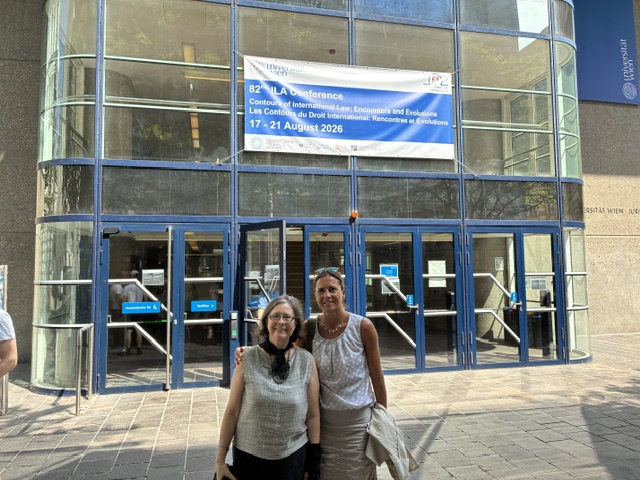
Professor Milena Sterio participated in the Biennial Meeting of the International Law Association in Vienna, Austria, from August 17-21.  Professor Sterio is a member of ILA’s Rights of Nature Committee. In that capacity, she contributed to the elaboration of the Committee’s first report, available here. She also participated in Committee deliberations in Vienna. 

In addition, Professor Sterio is a member of ILA’s newly founded Study Group on Rule of Law, and she participated in the Study Group’s first meeting and deliberations in Vienna.  Professor Sterio is on the Board of Directors of the American Branch of the ILA, where she also serves as Co-Director of Studies and Co-Chair of the Gender Justice in International Law Committee.  

Professor Sterio, right, at the ILA Conference.

Professor Sterio Participates in Event on Women’s Inclusion in International Law

Professor Milena Sterio participated in an event entitled “Women’s Equal and Inclusive Representation in International Law: Learning Lessons and Overcoming Barriers” on June 10 at the United Nations in New York City. The event was organized by the Permanent Mission of Vietnam to the UN, and it was co-sponsored by the Permanent Missions of Canada, Mexico, Spain, Portugal and Belgium, as well as by the Gender Justice Committee at the American Branch of the International Law Association (which Professor Sterio co-founded and which she co-chairs).

Picture, by Professor Sterio, of UN event, “Women’s Equal and Inclusive Representation in International Law: Learning Lessons and Overcoming Barriers”
Professor Sterio at the UN conference.

Professor Sterio Presents at International Law Scholarly Workships

Professor Milena Sterio participated in the American Society of International Law – International Courts and Tribunals annual workshop at Fordham Law School on May 15. Professor Sterio served as commentator for a paper by Professor Maggie Gardner (Cornell Law School) on the presumption against extra-territoriality. 

Professor Sterio also presented at the William & Mary Law School workshop on international law on May 21. The workshop – by invitation only – assembled a small group of international law experts. Professor Sterio presented her paper on the topic of “Artificial Intelligence and the Use of Autonomous Weapons.” A version of this paper will be published by the American University International Law Journal.

Professor Sterio Comments on ICC Prosecutor Alleged Misconduct

Professor Milena Sterio was quoted in a JusticeInfo article entitled “How Khan’s Investigation Mess Creates Factions.” She commented on the ongoing investigation into alleged misconduct of ICC Prosecutor Karim Khan.

Professor Sterio was one of four main drafters of the recently issued statement by the American Branch of the International Law Association ICC Committee, which had criticized procedural irregularities regarding the ongoing investigation into Khan’s alleged misconduct.

Professor Sterio Presents in the Hague on International Criminal Justice

Professor Milena Sterio presented at the International Bar Association War Crimes Committee conference in The Hague, Netherlands, on April 20. Professor Sterio’s panel focused on the theme of “Justice Running on Empty,” and Professor Sterio spoke about funding and other challenges regarding international criminal justice today.

Professor Sterio Quoted by PolitiFact

Professor Milena Sterio was quoted in an article by PolitFact on April 2, on the topic of “It is a war crime to bomb civilian infrastructure, as Donald Trump has threatened?” 

Professor Sterio explained that bombing a civilian target intentionally is “a flagrant violation of international humanitarian law,” which “would give rise to a war crime.”  Professor Sterio also opined on the status of Additional Protocol I to the Geneva Conventions.  She stated that the Protocol has “the status of customary law, which is binding on all states,” and that “[i]t doesn’t not matter that the U.S. is not a member of the protocol.”