Professor Deborah Hoffman, Visiting Assistant Professor of Law at Cleveland State University College of Law, was featured in a news segment by WEWS News 5 Cleveland addressing legal issues related to prolonged road construction and its impact on local businesses.
The story focuses on a Geneva, Ohio business affected by extended infrastructure work. Professor Hoffman provided commentary on legal considerations involving business access, notice, and the limits of government authority.
The segment includes both a written article and video interview and is available here.
On February 4-5, Seton Hall Law School hosted its first “Faith, Values, and the Rule of Law,” an interdisciplinary conference that hosted theologians, philosophers, and legal scholars. On the first day, during the first opening session, Professor Kalir presented his paper “Jewish Human Dignity: Equality Before God & Men,” which was well received. The Conference hosted both national and international scholars of all stripes and religions, and was crowned a great success.
Professor Milena Sterio was an invited speaker at the Armenian International Law Association Conference in Yerevan, Armenia, on February 14, in Yerevan, Armenia, “Rethinking International Law: Knowledge, Action, Reflection.”
She presented on a panel titled “International Courts and Beyond: Various Pathways of International Law Enforcement” on the specific topic of The Role of Domestic Courts in Global Peace and Security. In her remarks, Professor Sterio focused on how different courts can play a role in transitions toward peace and security, by holding states responsible for international law violations, and by imposing individual criminal responsibility on perpetrators of atrocity crimes.
Professor Milena Sterio co-hosted a new episode of the International Law Chats podcast, a monthly podcast by the American Branch of the International Law Association co-hosted by Professor Sterio, Professor Chiara Giorgetti (University of Richmond Law School), and Alison McDonald, KC. The episode, published on Feb. 2, 2026, featured as guest Professor Harold Koh, Yale Law School, speaking on “The Future of the International Legal Order.” Professor Koh is the most highly cited international legal scholar; he is former dean of Yale Law School as well as former Legal Advisor to the U.S. State Department.
Professor Milena Sterio has been invited to submit an article to La Trobe University’s (Melbourne, Australia) inaugural volume of the La Trobe University Law Review. The volume will focus on the theme “AI on the Battlefield: Navigating Legal and Ethical Frontiers in 21st Century Conflict,” and Professor Sterio’s article will focus on the issue of individual criminal responsibility for operators of autonomous weapons systems which use AI.
Professor Milena Sterio has accepted a publication offer from the American University International Law Review, one of the most prestigious international law journals, for her article “Artificial Intelligence, the Use of Autonomous Weapons, and Individual Criminal Responsibility: A Paradox or a Possibility.” The article will be published in the journal’s forthcoming 2026 issue.
Professor Milena Sterio ranks 39th in the United States in Scholarly Impact Rankings for International Law scholars, according to Hein Online. Hein Online publishes a list of top 100 scholars by subject area, and Professor Sterio is listed in the International Law Impact Rankings. The impact rankings are based on the number of citations, as well as additional factors.
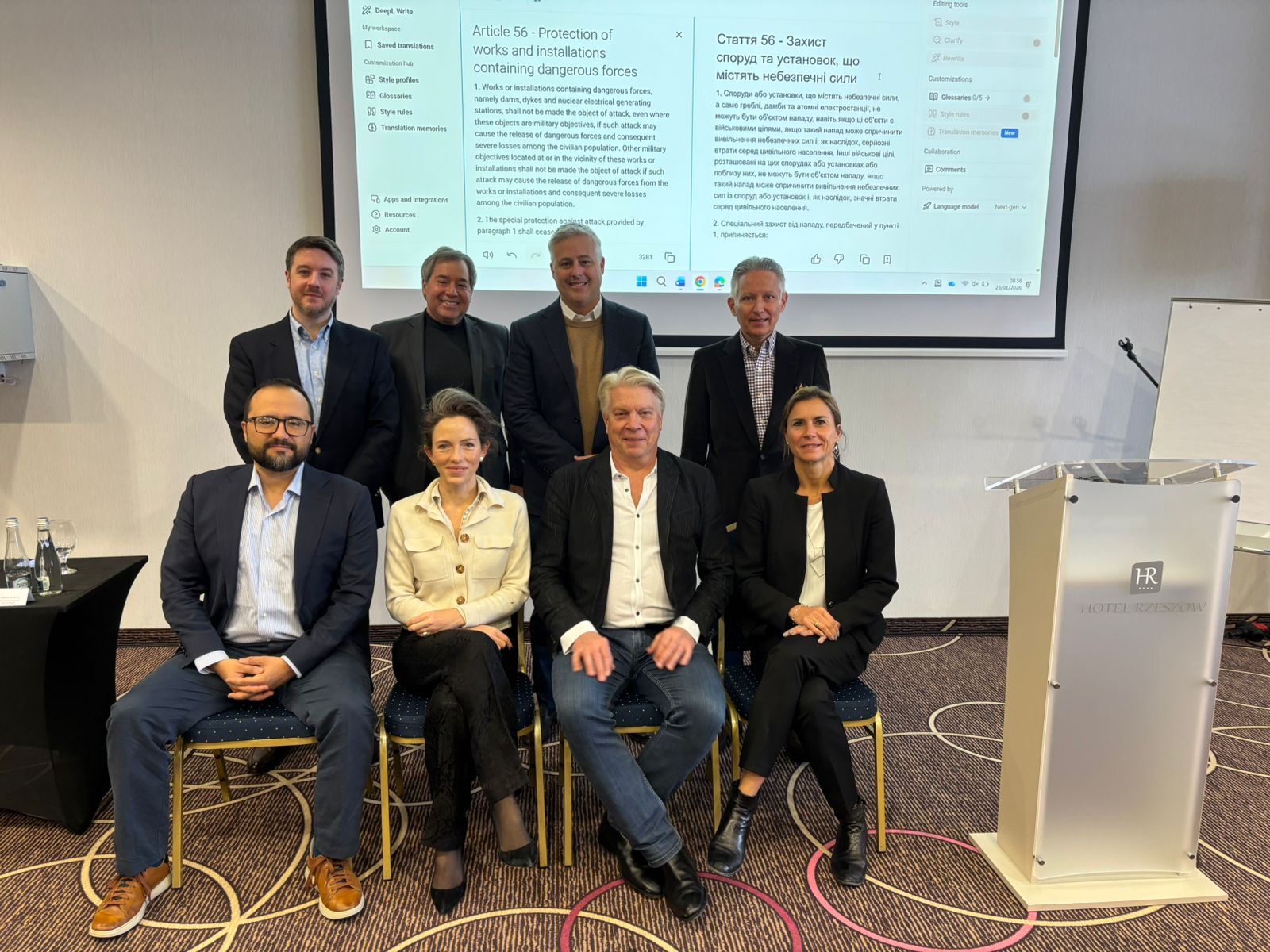
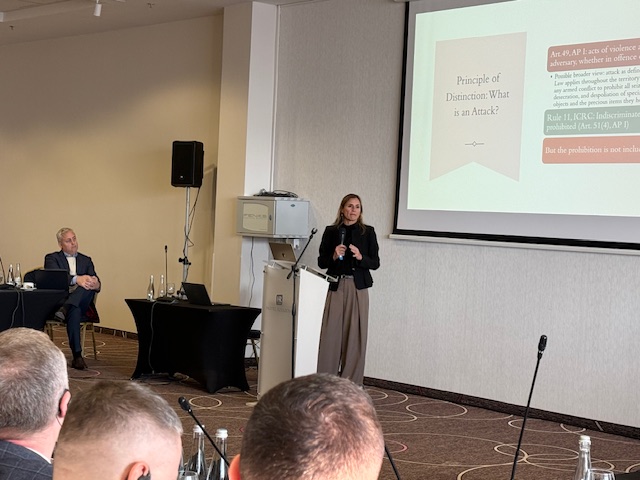
Professor Milena Sterio participated as an expert in a week-long training of Ukrainian judges and prosecutors on International Humanitarian Law, War Crimes Prosecutions, and International Environmental Law, from January 19-23, in Rzeszów, Poland.
The training was organized by the International Bar Association, and the expert team, in addition to Professor Sterio, consisted of professors and practitioners from the United Kingdom, Brazil, Chile, and the United States. Professor Sterio delivered two presentations about the sources of International Humanitarian Law and the fundamental principles of International Humanitarian Law. In addition, she also led several discussion groups and simulated exercises, where she guided Ukrainian colleagues across various evidentiary challenges as they relate to complex war crimes trials. This was Professor Sterio’s second trip to Poland as an expert; she had previously participated in a similar training in September 2024.
Professor Sterio (front row, far right) with other experts at the training program.Professor Sterio presenting on the Principle of Distinction during a training session for Ukrainian judges and prosecutors in Rzeszów, Poland.
Professors Milena Sterio and Kyle Shen spoke at a public forum at the CSU College of Law on January 13, on the topic of “The U.S. Attacks Against Venezuela: Does Might Make Right?” The event was recorded and is available on demand.
Professors Sterio and Shen discussed various international law issues related to the January 3 U.S. attack against Venezuela, as well as the kidnapping of Venezuela’s President Nicolas Maduro and his wife. Some of the international law topics discussed included use of force issues under the United Nations Charter and related customary law; jurisdiction to enforce; the ability of federal courts to prosecute defendants who had been forcibly brought to the U.S.; recognition of governments; and head-of-state immunity. In addition, Professors Sterio and Shen discussed the global implications of U.S. actions in Venezuela, and the risks associated therewith from a multi-lateral geo-political perspective.
This event was sponsored by CSU College of Law’s International Law Center.
Professor Milena Sterio participated in an episode of the Legal Face-Off Radio Program on Chicago’s WGN station. In this episode, Professor Sterio was interviewed regarding the legality of U.S. action in Venezuela, including the kidnapping of Venezuela’s President Maduro, as well as the prosecution of Maduro and his wife in the Southern District of New York. The episode is available on the WGN Radio website, as well as on various social media:
Professor Sterio concluded that the U.S. actions in Venezuela were illegal under international law as they violated the U.N. Charter as well as corresponding customary law, which bans states from using force against each other. Professor Sterio also opined that the U.S. prosecution of Maduro in the Southern District of New York will most likely proceed. She explained that U.S. federal district court judges tend to defer to the executive branch on matters implicating foreign relations and national security. Moreover, there is Supreme Court precedent confirming that a forcibly kidnapped defendant can nonetheless be prosecuted in U.S. court, and precedent from the 1989-90 Panama situation, where the leader of Panama, General Noriega, was prosecuted by U.S. court despite his claims of sovereign immunity. Last, Professor Sterio discussed legal issues surrounding the enforcement of arrest warrants extra-territorially; she concluded that jurisdiction to enforce is purely territorial under international law and that the U.S. violated international law when it arrested Maduro in Venezuela.
 CSU Law Faculty