
Professor Sterio Participates in International Law Association Meeting in Vienna

Professor Milena Sterio participated in the Biennial Meeting of the International Law Association in Vienna, Austria, from August 17-21.  Professor Sterio is a member of ILA’s Rights of Nature Committee. In that capacity, she contributed to the elaboration of the Committee’s first report, available here. She also participated in Committee deliberations in Vienna. 

In addition, Professor Sterio is a member of ILA’s newly founded Study Group on Rule of Law, and she participated in the Study Group’s first meeting and deliberations in Vienna.  Professor Sterio is on the Board of Directors of the American Branch of the ILA, where she also serves as Co-Director of Studies and Co-Chair of the Gender Justice in International Law Committee.  
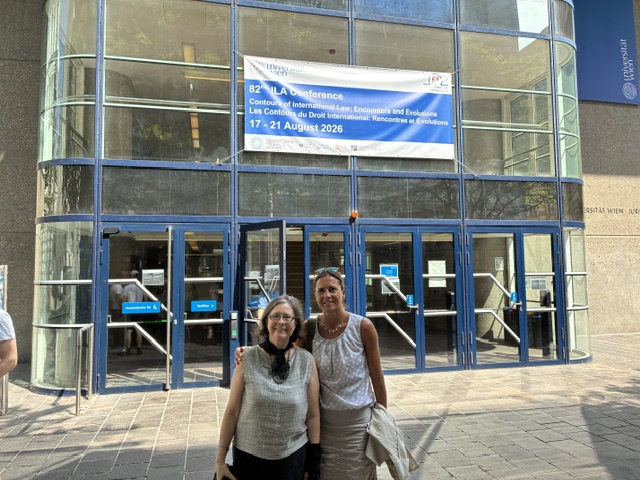
Professor Sterio, right, at the ILA Conference.

Professor Hoffman Publishes Response to Hamm v. Smith

On July 27, Professor Laura Hoffman, Co-Director of the CSU Law Center for Health Law and Policy, published a blog post on “Bill of Health,” a publication of Harvard Law School’s Petrie-Flom Center. Professor Hoffman’s post, “Intellectual Disability, Geography, and a Life-or-Death Decision” discusses the U.S. Supreme Court’s recent ruling Hamm v. Smith, involving the issue of determining intellectual disability in death penalty cases.

Professor Hoffman notes that the Hamm case had been “watched by both criminal justice and disability rights advocates for its potential impact on convictions for individuals sentenced to death involving a determination of intellectual disability.” However, the Court ultimately dismissed the case as improvidently granted, thus providing no further clarification on the legal standard.

Professor Hoffman argues that “people with disabilities and their advocates have been fighting for — and very much deserve — a unified standard that still allows an individualized assessment of the individual, not just cherry-picking certain criteria like an IQ score to define intellectual disability.”

Professor Luisetto Publishes Two Articles on Noncompetes and Mobility-Restricting Covenants

Professor Lorenzo Luisetto has published two new articles examining mobility-restricting covenants, including noncompete agreements, across different contractual contexts. Noncompete agreements and other mobility-restricting covenants have mainly been studied at the level of the employment relationship, but other contractual contexts can be just as important in disciplining their use.

In “Mobility-Restricting Covenants in Business Contracts: The Case of Franchising,” published in the Journal of Empirical Legal Studies, Professor Luisetto, together with Francine Lafontaine and J.J. Prescott, examines the use of several types of covenants, including noncompetes, but also confidentiality and non-recruitment clauses, in franchise contracts.

In “Collective Bargaining and Monopsony: The Regulation of Noncompetes in France,” published in Industrial Relations, Professor Luisetto, together with Tito Boeri, Tommaso Crescioli, and Andrea Garnero, studies what happens when unions regulate the use of noncompetes through collective bargaining.

Both articles are now available online in open access:

(JELS): https://onlinelibrary.wiley.com/doi/10.1111/jels.70033

(IREL): https://onlinelibrary.wiley.com/doi/10.1111/irel.70036