Professor John Plecnik was featured on Cleveland.com as part of an article on Millennials who serve Northeast Ohio in public office. Entitled “Millennials in office: A new generation of politics and public service,” this article highlights sixteen officeholders under the age of thirty-five and asks them about their generation’s perspective on public service. As Vice President of Council and Councilman-at-Large for the City of Willoughby Hills, Professor Plecnik expressed hope that Millennials will bring a “fresh approach” to public service with “more focus on balancing our budget, dealing with the national debt, and creating a sustainable plan for America’s future.” The article is available here.
Category Archives: Faculty in the Media
Professor Weinstein Presents at Three Sessions at American Planning Association’s Conference in Phoenix, Arizona
Professor Alan Weinstein presented at three sessions during the American Planning Association’s (APA) National Planning Conference in Phoenix, April 2-5. On Sunday, April 3, he presented “Recent Changes to FCC Rules Governing Local Government Telecommunications Regulations” as part of an Alfred Bettman Law Symposium session titled “Federal Regulations Affecting Land-Use Decisions” that he organized. That same day he also presented “The Effect of Reed v. Town of Gilbert on First Amendment Rulings in the Lower Courts” as part of a session titled “Local Sign Regulation” organized by the Arizona Chapter of the APA. On Monday, April 4, he presented “What Can (and Should) Local Governments Do About Racial and Income Segregation in Housing,” as part of an Alfred Bettman Law Symposium session titled “Planning as if ‘Black Lives Matter,’ ” that he organized.
Professor Sterio Publishes Blog Post on the ICTY Karadzic Verdict
Professor and Associate Dean Milena Sterio published a blog post entitled “Radovan Karadzic Convicted by ICTY Trial Chamber” on Intlawgrrls. Professor Sterio’s blog post, available here, discusses the Karadzic verdict, delivered on March 24, 2016. Radovan Karadzic was the Bosnian Serb leader during the conflict in the former Yugoslavia in the 1990s. He spent several years in hiding, after the end of the conflict, and was ultimately found and arrested in Belgrade in 2008. He was then transferred to the International Criminal Tribunal for Yugoslavia at the Hague, where he faced trial on multiple charges of genocide, crimes against humanity and war crimes. Karadzic was convicted of most counts and sentenced to 40 years in prison, which, in light of his current age (70), most likely amounts to life imprisonment.
Professor Robertson Presents at International Academic Association Conference at the University of Bern, Switzerland
Heidi Gorovitz Robertson, C|M|LAW’s Steven W. Percy Distinguished Professor of Law, attended the 10th International Academic Association for Planning, Law, and Property Rights conference at the University of Bern, Switzerland. On a February 17, 2016, panel with Prof. Daniel Tarlock (Chicago-Kent) and Deborah Musiker (Northwestern), she presented Seeking Local Control: When a State’s Legislation and Constitution Collides with Local Government’s Quest to Influence Shale Development.
Professor Davis’ Scholarship Has the Most Views Among CM Law Professors on ResearchGate
For the second month in a row, Professor Mickey Davis’ scholarship on legal issues related to pharmaceutical pricing, has garnered the highest number of views among Cleveland-Marshall College of Law professors on ResearchGate. Congratulations to Professor Davis!
Professor Brian Ray’s Book on Social Rights in South Africa Featured on ICONnect Blog Roundtable

Professor Brian Ray
ICONnect, the blog of the International Journal of Constitutional Law, recently featured Professor Brian Ray’s new book, Engaging with Social Rights: Procedure, Participation and Democracy in South Africa’s Second Wave (Cambridge forthcoming 2016), in a virtual book review roundtable discussion. The virtual roundtable, available here, was introduced by Professor Richard Albert of the Boston College Law School, and the participants included Professor Ray himself, as well as Professor Bernadette Atuahene from the Chicago-Kent College of Law and Professor Richard Stacey from the University of Toronto Faculty of Law.
Here is a brief description of Professor Ray’s book:
With a new and comprehensive account of the South African Constitutional Court’s social rights decisions, Brian Ray argues that the Court’s procedural enforcement approach has had significant but underappreciated effects on law and policy and challenges the view that a stronger substantive standard of review is necessary to realize these rights. Drawing connections between the Court’s widely acclaimed early decisions and the more recent second-wave cases, Ray explains that the Court has responded to the democratic legitimacy and institutional competence concerns that consistently constrain it by developing doctrines and remedial techniques that enable activists, civil society and local communities to press directly for rights-protective policies through structured, court-managed engagement processes. Engaging with Social Rights shows how those tools could be developed to make state institutions responsive to the needs of poor communities by giving those communities and their advocates consistent access to policy-making and planning processes.
Professor Mead’s Op-Ed Published by Plain Dealer/Cleveland.com
In an op-ed recently released on Cleveland.com, http://www.cleveland.com/opinion/index.ssf/2016/03/akron_can_start_its_own_crimin.html, Professor Mead calls on the City of Akron to change its anti-homeless policies. In the op-ed, Professor Mead urges the City to reconsider its anti-panhandling law and the City’s alleged practice of destroying homeless encampments, arguing that there are cheaper, more productive ways to alleviate homelessness. Professor Mead is also working with Professor Doron Kalir and students from the Cleveland-Marshall Civil Litigation Clinic on litigation related to these issues.
Professor Weinstein Co-Authors Article (with Brian Connolly) on Reed v. Town of Gilbert Case
An article critiquing the Supreme Court’s June 2015 decision in Reed v. Town of Gilbert co-authored by Alan Weinstein and Brian Connolly, a Denver-based attorney/planner, has been published in 47 Urb. Law 569 (2015). In their article, titled “Sign Regulation After Reed: Suggestions for Coping With Legal Uncertainty,” Weinstein and Connolly discuss the first amendment questions left unanswered by Reed, including whether that decisions “on its face” rule for determining whether a sign regulation is content-based applies to regulations that distinguish between commercial and non-commercial signs or between on-site and off-site signs. The article also discusses the effect Reed may — or may not — have on other first amendment issues, including the “secondary effects” doctrine and “speaker-based” regulations. The article concludes with suggestions for how local governments should revise their sign regulations to ensure compliance with Reed.
Professor Forte’s Recent Lectures and Debates
Professor David Forte has recently given the following lectures and engaged in the following debates:
“Is Chief Justice Roberts a Radical on Free Speech Rights?” Address to Forth Worth Federalist Lawyers’ Chapter, Forth Worth, Texas, March 3, 2016;
“SCOTUS Without Scalia,” Panel Discussion with Professor Michael Ariens, St. Mary’s Law School, San Antonio, Texas, March 2, 2016;
“Religious Liberty Today,” Debate with Professor Thomas Stacy, University of Kansas Law School, Lawrence, Kansas, March 1, 2016;
“Could Obergefell be the Worst Decision in the U.S. Supreme Court History?” Debate with Professor Gary Allison, University of Tulsa Law School, Tulsa, Oklahoma, February 29, 2016.
Professor Mika Presents at Workshop at University of Maryland School of Law and at Rocky Mountain Regional Legal Writing Workshop
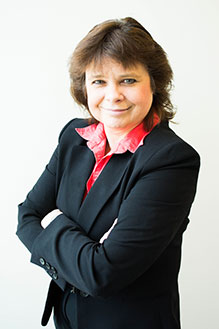
Professor Karin Mika
On March 11th, Professor Karin Mika was a facilitator for the ALWD sponsored Scholarship Workshop at the Capital Area Regional Legal Writing Workshop, held at the University of Maryland School of Law in Baltimore. On March 12th, Professor Mika presented on the topic of “Teaching Grammar to a New Generation of Learners.”
On March 19th, Professor Mika presented at the Rocky Mountain Regional Legal Writing Workshop, hosted by the University of Arizona Law School in Tucson. Her topic was “What Brain Games has taught me about teaching.” In her presentation, Professor Mika discussed the show “Brain Games,” on the National Geographic Channel, and how the show discussed certain features of how the brain acquires and retains information. Professor Mika focused on discussing learning where there are distractions, and how older and younger brains process information much differently. She used the examples from Brain Games to discuss how understanding younger brains helps in determining which teaching methods should best be used to reach our students.
 CSU Law Faculty