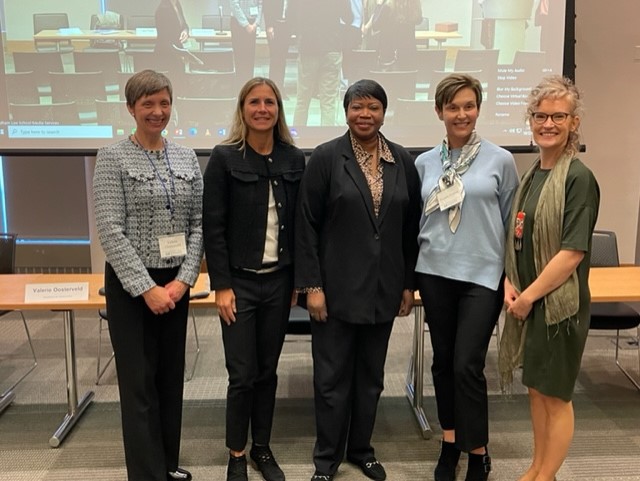
Professor Milena Sterio, along with a group of experts, submitted a Comment to the International Criminal Court’s Office of the Prosecutor on November 23. The Comment was submitted in response to the Office of the Prosecutor’s Request for Comments from experts on its draft policy on the prosecution of the crime of sexual persecution. Professor Sterio and her expert colleagues, in their Comment, focused on the distinction between motive and intent within the prosecution of the crime of sexual persecution, and on the need to develop a comprehensive regime of victim participation within the context of such prosecutions.
Author Archives: CSU|LAW
Professor Kalir Interviewed on Attempt to Disqualify Trump from the Presidency
Professor Doron Kalir was quoted in an article on Verify titled, “Whether 14th Amendment applies to Trump depends on 3 eligibility questions.”
In the wake of former President Trump’s announcement that he will run for the presidency again, House Democrat Rep. David Cicilline (D-R.I.) is considering legislation to disqualify him from doing so based on the 14th Amendment’s Disability Clause (Section 3). In short, the Clause prevents some persons who “engaged in insurrection” to run for certain offices.
Professor Kalir, who was interviewed by Verify about the issue, opined that the Clause cannot apply to Trump for two reasons: First, the President is not listed in the Clause as one of the persons who could potentially “engage in insurrection.” And second, even if he did, while the Clause prevents a run to many an office, it does not prevent a run for the office of Presidency itself. Accordingly, according to Kalir, the Clause does not apply to Trump, and cannot prevent him from running for office.
Professor Chien Presents Empirical Project on Asian Americans in the Law
Professor Steven Chien presented his empirical project, Portrait Project 2.0 – A Portrait of Asian Americans in the Law, at the 2022 National Asian Pacific American Bar Association (NAPABA) Convention from November 3-6 in Las Vegas.
The project originated with A Portrait of Asian Americans in the Law, the first comprehensive account of the progress of Asian Americans in the legal profession, which was presented at the 2016 NAPABA convention in San Diego. The final report, published in 2017, has provided a crucial resource for advocacy by and on behalf of Asian Americans in law firms, the corporate sector, government, and many other settings where the Asian American community continues to be under-represented, especially at the top levels of leadership. The report has been cited extensively in the media and in proceedings before Congress and state courts.
Professor Chien served as part of the research team that completed this five-year update of the Portrait Project and presented it at the NAPABA convention. The new report updates previous findings on Asian American representation in diverse sectors of the legal profession. It also has several new components, including data on Asian American lawyers’ experiences and perceptions of their role in light of the pandemic and anti-Asian racism, as well as ethnic subgroup comparisons that shed light on diversity within the Asian American community. The updated report gives a concrete representation of the experiences of Asian Americans in the legal profession, and it provides a comprehensive empirical foundation for continued advocacy to advance the interests and aspirations of Asian American lawyers. As with the original 2017 report, the updated 2022 report will be a critical resource of interest to every member of our community.
Sagers Quoted in The Atlantic on Congress’s Peculiar Habits
Chris Sagers, the James A. Thomas Professor of Law, spoke with The Atlantic for an article titled, “How Did America End Up With the Z.O.M.B.I.E. Act?” about the peculiar congressional habit of naming statutes with clever acronyms. The story was influenced in part by Sagers’ 2014 Georgetown Law Journal article on the same topic.
Professor Mika Publishes on Teaching as a First Generation American
Professor Karin Mika has published an article titled “The Power of Vulnerability in Promoting a Sense of Belonging: The Perspective of a First Generation American.” The article appears in “The Second Draft,” a publication of the Legal Writing Institute. In the article, Professor Mika discusses how growing up as a child of immigrants affords the opportunity to better connect with students through assignments that foster communication and connection.
Professor Kalir Publishes Op-Ed on Affirmative Action
Professor Doron Kalir has published an op-ed titled, “The Supreme Court is poised to eliminate affirmative action,” on Cleveland.com.
Professor Robertson Presents at Pace Environmental Law Symposium
Professor Heidi Gorovitz Robertson participated in the Pace Environmental Law Review’s Fall 2022 Symposium on Environmental Constitutionalism. Her panel focused on Environmental Rights – Development and Design.
Robertson’s talk was titled Considerations for the crafting of subnational constitutional rights to a clean environment. It focused on her experience teaching an intersession course at the University of Maine School of Law during the period in which the Maine Legislature was considering whether to move a proposed environmental rights constitutional amendment to the voters. The course considered the environmental rights provisions in six U.S. state constitutions and compared their language and placement to Maine’s proposed environmental rights amendment – the Pine Tree Amendment. Robertson also worked with Maine legislators to understand the impact of other states’ environmental rights amendments on litigation rates, business, and other concerns. Although a majority of both houses of the Maine legislature supported the amendment, they did not do so with sufficient margins for the amendment to proceed to the voters.
The resulting article will be published next summer by the Pace Environmental Law Review. Robertson is the Steve W. Percy Professor of Law at C|M|LAW and Professor of Environmental Studies at the College of Education and Public Affairs.
Professor Laser Presents at University of Chicago Seminar
On Oct 17, Professor Christa Laser presented at a seminar at University of Chicago on legal issues in blockchain and web3. She discussed a work-in-progress paper that covers securities law, intellectual property law, and right of publicity issues for cryptocurrencies, NFTs, and other blockchain assets.
Professor Kalir featured in a Law360 Article on Record Sealing in Ohio
Professor Doron Kalir was recently quoted in Law360 about a recent Ohio Supreme Court decision involving record sealing.
The case, State ex rel. Cincinnati Enquirer v. Forsthoefel, involved the divorce records of three-time U.S. Senate candidate Josh Mandel. The Ohio Supreme Court held that judges must reason their opinions, and attorneys must provide strong evidence, in order for a sealing decision to stand.
The trial judge in the case had agreed to seal the records without reasoning. The parties who moved to seal the records provided no affidavits in support. Both were wrong, held the Supreme Court in reversing the decision.
Professor Kalir commented, “the rule is very clear that if and when a judge wants to overcome the presumption of a hearing and restrict public access, they have to do a lot of yeoman’s work.”
Professor Sterio Speaks at International Law Weekend
Professor Milena Sterio participated in International Law Weekend, a prestigious international law conference in New York City organized by the American Branch of the International Law Association. Professor Sterio serves on the Board of Directors of ABILA; in addition, she was a member of the organizing committee of ILW. At ILW, Professor Sterio moderated two panels. On October 22, she moderated a panel discussion on Racism and the Crime of Apartheid under International Law. On the same day, she also moderated a panel discussion on Prosecuting Sexual and Gender-Based Violence Crimes at the International Criminal Court. Professor Sterio had organized the latter panel.