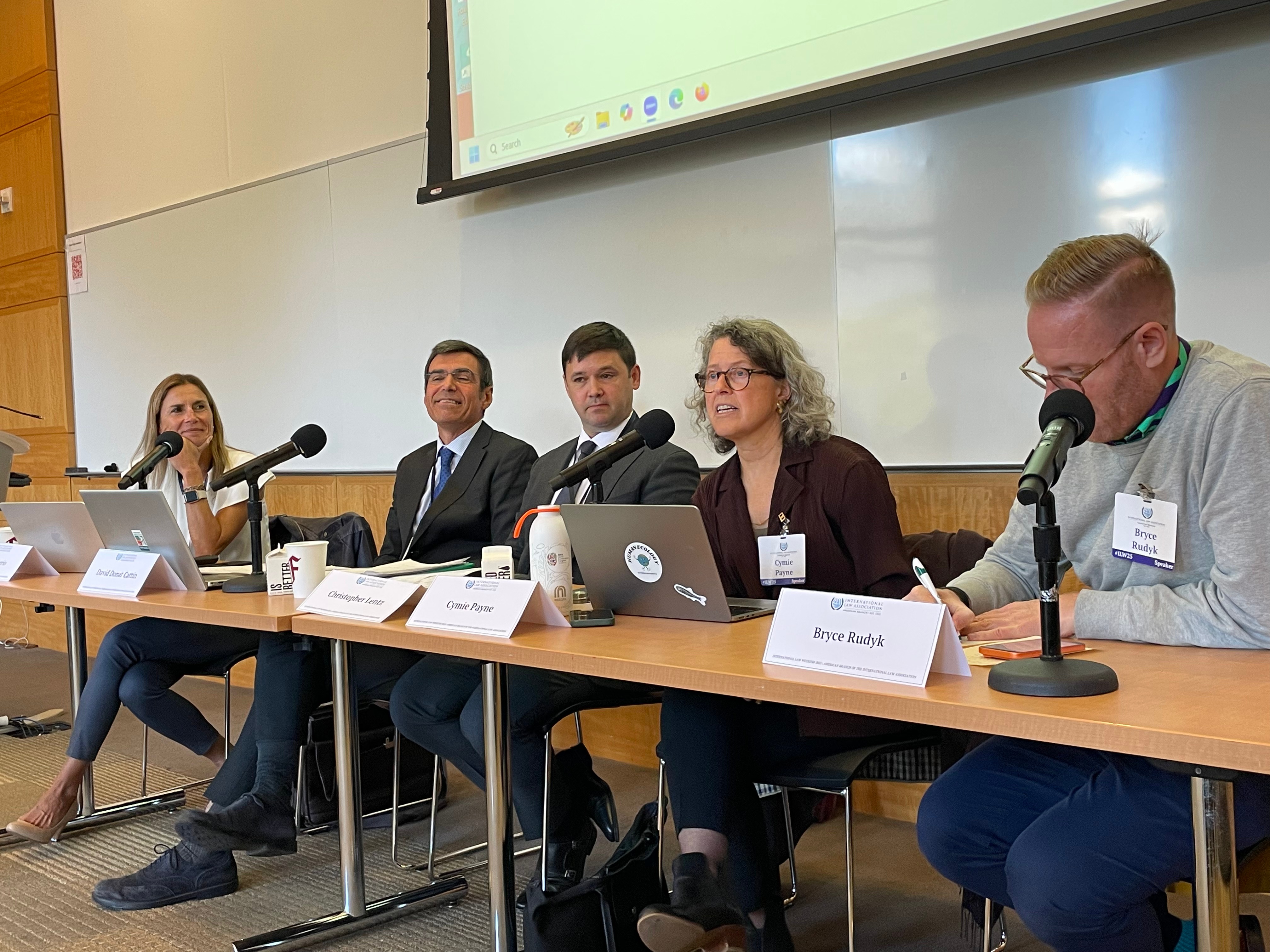
C|M|LAW Legal Writing Professor Claire Robinson-May presented “Enhancing Understanding by Inviting Student Creativity into the Legal Writing Classroom,” on April 26, 2014, at the Southeastern Legal Writing Conference held at Stetson University College of Law. In her presentation, May noted that teachers of legal writing rarely offer students an opportunity to be creative. Rather, they regularly ask students to produce research logs, memos, motions, and other documents that are similar to those produced by their peers. But, in addition to teaching legal writing, May is also pursuing an M.F.A. in creative writing. She brought that experience into her legal writing classroom and invited her law students to bring in their creativity as well. May’s presentation described an assignment in which she required students to outline and analyze a statute and then convey the information to the class through a creative presentation. Student group presentations included an original song, an interactive game, a comic strip, a public service announcement, an original children’s book, and more. May believes the assignment enhanced student understanding of the material by engaging student creativity in the learning process.
Category Archives: Faculty News
Falk to Serve on Cuyahoga County Prosecutor’s First Conviction Integrity Unit
C|M|LAW Professor Patricia J. Falk has been appointed to serve on Cuyahoga County Prosecutor Timothy McGinty’s newly announced Conviction Integrity Unit. Falk, along with the other members of the group, will review innocence claims made by felons convicted of crimes in Cuyahoga County. In particular, the group will review applications from prison inmates, attorneys and felons who believe they were wrongly convicted.
For a Plain Dealer article on the topic, as well as a link to the Prosecutor’s Office’s full policy on the topic,click here:
http://www.cleveland.com/court-justice/index.ssf/2014/04/new_conviction_integrity_unit.html
Robertson Writes in Crain’s on Ohio Supreme Court Oral Argument regarding Local Attempts to Regulate Zoning of Shale Wells
C|M|LAW Professor and Associate Dean Heidi Gorovitz Robertson published Awaiting the court’s word on validity of local zoning control of well locations, in Crain’s Cleveland Business’ Energy Report on April 4, 2014. In this post, Robertson notes that many Ohio communities hope to exercise some control over the shale oil and gas activities that will take place within their jurisdictions. Monroe Falls, in particular, would prohibit drilling in residentially zoned space and impose some other local requirements.
If the Ohio Court of Appeals was the end of the line, Monroe Falls’ zoning ordinance would be dead in the water, along with other local efforts to enact similar ordinances affecting the location of wells. But Monroe Falls appealed to the Supreme Court of Ohio and on February 26, 2014, the Court heard oral argument on two specific issues. First, it considered whether the state statutes concerning oil and gas drilling deprive municipalities such as Monroe Falls of their Ohio Constitutional home rule authority to enact and enforce zoning laws (such as prohibiting shale drilling in residential zones). The second issue was whether Monroe Falls’ ordinances, some of which required oil and gas drillers to submit information to Monroe Falls conflict with the state’s oil and gas law when the driller has already secured a drilling permit from ODNR.
Ohio and the affected driller, Beck Energy, argued that if the court allows localities to create their own rules, even zoning rules, the practice would undermine the state’s ability to carry out the Legislature’s statutory directives. Monroe Falls, however, argued that local land-use regulation could operate in harmony with the state’s control of drilling operations and would not, therefore be pre-empted by the state law.
A couple of justices expressed serious doubts that ODNR really has “sole and exclusive authority” to preclude all local oversight with no administrative appeal. At least one seemed bothered that the statute does not expressly state a preclusion for municipal zoning authority, whereas the Legislature has shown that it knows how to do this in other statutes. Justice Paul Pfeifer focused on the fact that under Ohio’s oil and gas statute, a driller can appeal a denied drilling request to the state agency, but a landowner has no opportunity to appeal the state’s decision to grant a driller’s permit request.
Only a few of the justices spoke up substantially at the oral arguments. We’ll have to wait to hear from the others when the opinion is released. In the meantime, localities across the state will be watching to learn whether they will be able to decide where shale oil and gas drilling may occur within their borders.
To read the full post in Crain’s, click here:
Lewis Speaks at Columbia on Reproductive Technology and Parenting
On April 9, 2014, C|M|LAW’s Leon and Gloria Plevin Professor of Law Browne Lewis presented a lecture at Columbia University’s Mailman School of Public Health. The lecture dealt with the of impact reproductive technology on legal parentage. Professor Lewis discussed the factors courts consider when determining the legal mother of a child conceived as the result of a surrogacy arrangement. She also explained the manner in which the court adjudicates the paternity of a man whose wife is artificially inseminated with donor sperm and with an anonymous sperm donor. Lastly, she analyzed the public health consequences of creating designer children using reproductive technology.
In addition, Professor Lewis was recently elected to the AALS Women in Legal Education Archives Subcommittee. This Committee is charged with reviewing the contents of the current archives; creating a mechanism to share the archival information with our members; adding oral histories and other additional data to the archives; and maintaining the Schlesinger Archives.
Plecnik’s “Modest Proposal” for a Constitutionally Apportioned Wealth Tax Published in Hastings Constitutional Law Quarterly
C|M|LAW Professor John Plecnik’s article, The New Flat Tax: A Modest Proposal For a Constitutionally Apportioned Wealth Tax, was published in the Hastings Constitutional Law Quarterly at 41 Hastings Const. L.Q. 483 (2014). As usual, Professor Plecnik begins with a flourish:
“Eat the poor children,” proposes Jonathan Swift.
“Nay,” protests Occupy Wall Street, “Eat the rich!”
His Article does not really propose eating the rich with draconically high taxes. However, he says, the United States has experienced years of multi-billion dollar deficits. Many liberals have proposed a European-style value added tax or VAT to balance the budget. Many conservatives have proposed a “fair” or flat tax. Like the Devil, regressive consumption taxes go by many names. Whether they know it or not, liberals and conservatives are proposing essentially the same thing — a federal sales tax, which disproportionately impacts the poor and middle class. Plecnik’s article counters with a truly modest proposal for the New Flat Tax on wealth rather than consumption.
Congressional power to “lay and collect Taxes” is subject to two rules. Indirect taxes must be uniform, whereas direct taxes must be apportioned so that states pay in proportion to their population. Under the Obamacare decision, there is little doubt that wealth taxes are direct taxes. However, levying a wealth tax based on population has the unfair result of different tax rates in different states.
For some time, scholars have debated ways to skirt the Apportionment Clause. For the first time, this Article demonstrates how a wealth tax may comply with Apportionment and still be fair. Under this Article’s proposal, the federal government would collect a wealth tax at a uniform rate and retain each state’s constitutionally apportioned share of the tax. The excess unapportioned share would be refunded to the state of origin via a state-level “pick up” tax. This revenue sharing arrangement — inspired by the pre-EGTRRA credit for state death taxes — ensures a uniform state and federal tax burden without redistributing wealth among the states. Thus, horizontal equity is achieved and both the letter and spirit of the law are satisfied.
You can read the full article on SSRN at:
http://papers.ssrn.com/sol3/papers.cfm?abstract_id=2423803
Falk Speaks about the Epidemics of Rape on College Campuses and in the Military
On March 29, 2014, C|M|LAW Professor Patricia J. Falk presented Is VAWA Enough?: The Epidemics of Rape on College Campuses and in the Military at a conference presented by Dusquesne Law School in Pittsburgh– The Violence Against Women Act and Its Impact on the U.S. Supreme Court and International Law.
Professor Falk explained that on January 22, 2014, President Barack Obama created a special task force to combat the epidemic of rape on college campuses. She noted that the statistics are alarming: one in five college women is either sexually assaulted or the victim of an attempted sexual assault during her college years, and only 10-12% of those who are sexually assaulted reported the attacks. Less than a month earlier, in December of 2013, President Obama had issued a warning to the military – that it had to decrease the number of sexual assaults experienced by service members within one year. The President stated that if improvement were not forthcoming, he would have to step in and take more aggressive measures himself. The statistics are also alarming. In Fiscal Year 2010, 19,000 service members were victims of sexual assault, and only about 14 percent of the victims reported the crime. A recent VA study indicated that nearly one in four women sent to Iraq or Afghanistan reported being sexually assaulted.
Professor Falk indicated that within the past few months, the Obama administration had identified two specific sites in our society that are in urgent need of reform in terms of sexual assault. In this talk, she explored whether these very different spaces have some things in common that make the crime of rape more likely to occur. She asked whether, if we can understand the characteristics that make these spaces fertile ground for sexual assault (i.e., more rape-prone), we might be able to turn the tide on these epidemics and make progress toward their eradication. In particular, she examined victims’ accounts, the juxtaposition of non-legal actors in decision making regarding the prosecution of rape, conflicts of interest in those to whom sexual assault is reported, motivated offenders and a surfeit of potential victims, the role of alcohol and drugs, and the current legal rules or systems.
Kalir Files Amicus Brief with United States Supreme Court
C|M|LAW Clinical Professor Doron Kalir, together with Civil Litigation Clinic students Amy Polomsky and Kate Southworth, filed an Amicus Brief with the United States Supreme Court on behalf of the National Association of Social Workers. The brief argues that social workers are entitled to qualified immunity whenever they make a reasonable decision to remove an abused child, even in the absence of a prior judicial hearing. Recently, in a 2:1 decision, the Sixth Circuit held that social workers are not entitled to qualified immunity under those circumstances. The social workers are currently seeking a grant of certiorari from the Court, and 13 States have filed an amicus in their support. Now, the National Organization of Social Workers (NASW) has joined them. The circuit split on the issue, and the fact that the Court has ruled on a related issue 25 years ago – but left this question unanswered – increase the likelihood that the Court will grant cert. in this matter.
Plecnik Publishes in Tax Notes on the EITC Ban and the Definition of “Reckless”
C|M|LAW Professor John Plecnik has published Reckless Means Reckless: Understanding the EITC Ban in Tax Notes at Vol. 142, No. 8, Feb. 24, 2014, p. 847. It was published electronically in Tax Notes Today.
In this article, Plecnik argues that Congress intended to incorporate in the earned income tax credit ban the well-established definition of reckless or intentional disregard from section 6662, which imposes the accuracy-related penalties. Plecnik has previously argued that the legislative history demonstrates Congress intended the same definition of reckless or intentional disregard for sections 32(k) and 6662. That argument was inspired by Plecnik’s work as pro bono counsel for the Legal Aid Society of Cleveland on two EITC ban cases in the Tax Court. Both cases were settled last fall on terms favorable to his clients with no ban or other penalties. Plecnik thanks Professor Leslie M. Book of Villanova University School of Law as well as Camille R. Gill and Susan E. Morgenstern, his co-counsels from Legal Aid.
Robertson Writes in Crain’s about the Pennsylvania Supreme Court’s Decision on Local Regulation of Shale Oil and Gas Development
On January 31, 2014, C|M|LAW Professor and Associate Dean for Academic Enrichment Heidi Gorovitz Robertson published a blog post, Pennsylvania’s Environmental Rights Might Snag Drillers, in Crain’s Cleveland Business’ Shale Report. Robertson has written previously in Crain’s about the struggles Ohio and other states face when local governments attempt to control local activities of the shale oil and gas industries. In particular, Ohio legislation seems effectively to preempt local regulation. An intermediate court in Ohio has upheld the state’s ability to prohibit such local regulation, but the Supreme Court of Ohio has yet to hear a case on this issue.
In neighboring Pennsylvania, however, the Supreme Court has struck down, on state constitutional grounds, the legislature’s attempt to preempt most local regulation of shale oil and gas drilling. To do this, the Pennsylvania court relied on an environmental rights provision in that state’s constitution. The court thus returned to Pennsylvania’s local governments the authority to regulate hydraulic fracturing as an industrial use under their land use and zoning ordinances. Pennsylvania’s preemption of local regulation of hydraulic fracturing appeared dead.
According to two state agencies, however, the Court’s decision was not supported by the facts, and on Jan. 2, 2014, they asked the Court to reconsider its December 2013 decision. We don’t know yet whether the Pennsylvania Supreme Court will agree to reconsider.
In the meantime, Ohio’s can ponder the possibilities. The Ohio and Pennsylvania Constitutions both have Home Rule provisions and some Ohioans have hoped that Ohio courts would use that provision to strike down Ohio’s legislative preemption of local oil and gas ordinances. So far, Ohio courts have not done this. Although Pennsylvania has a similar Home Rule provision, that state’s court did not rely on it to strike down the preemption of local regulation. Instead, it used the environmental rights provision. Ohio’s Constitution does not include an environmental rights provision.
To read the complete post, click here:
http://www.crainscleveland.com/article/20140131/SHALEBLOGS/301319996
Ray Writes on South African Court’s Emphasis on Procedure in Policy Decisions
C|M|LAW’s Joseph C. Hostetler – Baker & Hostetler Professor of Law Brian E. Ray recently published a blog post entitled South African Informal Traders Forum and Others v The City of Johannesburg and Others: A Promising Start by the South African Constitutional Court, on Oxford Human Rights Hub. In that decision, the South African Constitutional Court enjoined the City of Johannesburg from evicting informal traders in the inner city. Regarding this decision, Ray writes “Departing sharply from its normal procedures, the South African Constitutional Court recently issued what we in the States would call an “interim injunction” in a case pending before the South Gauteng High Court called South African Informal Traders Forum and Others v The City of Johannesburg and Others (“SAITF”). The order prohibits municipal authorities in Johannesburg from “interfering” with the activities of multiple street traders in the city center who are lawfully licensed to trade by the City.
Ray notes that the temporary injunction in the SAITF case is an example of this Court playing a stronger procedural role in policy decisions. Recent cases show that, “when operating in a role that it can safely characterize as procedural—especially when faced with a policy that either completely ignores or actively infringes upon social rights—the Court has been much more willing to exercise its authority to at least temporarily stop implementation of a challenged policy, and sometimes even to change it.”
To read this post, click here: