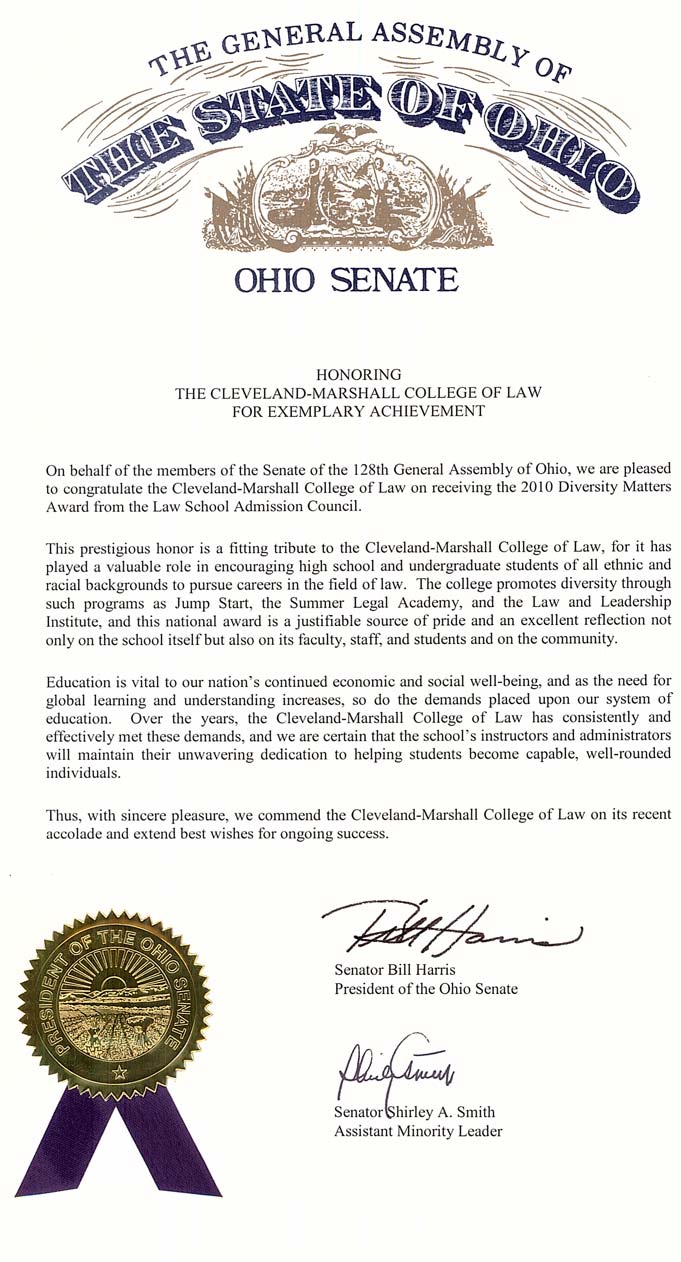
The 128th General Assembly of Ohio has honored C|M|LAW with a commendation for receiving the 2010 Diversity Matters Award from the Law School Admissions Council.
Ohio Senate Commendation

The 128th General Assembly of Ohio has honored C|M|LAW with a commendation for receiving the 2010 Diversity Matters Award from the Law School Admissions Council.
Ohio Senate Commendation
Professor David Forte
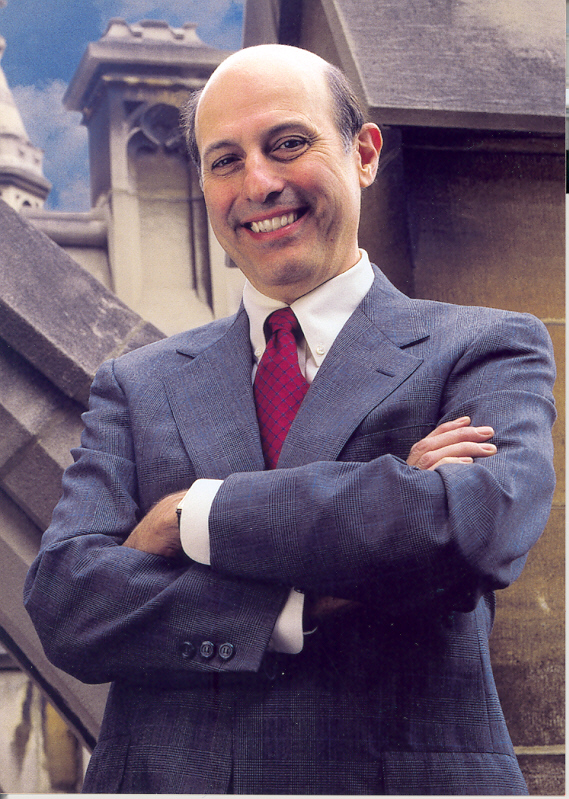
Professor David Forte has published Originalism in the Classroom in the current issue of Academic Questions. In this article, Forte evaluates the way we have taught law in the twenty-five years since Attorney General Edwin Meese’s plea to return to “a Jurisprudence of Original Intention.” Forte begins by looking at several US Supreme Court cases in the areas of church-state relations, 14th amendment Due Process, and abortion. It is through these cases, he argues, that the Court reawakened ideas of originalism. Following these cases, Forte writes, originalism became a legitimate and principled method of constitutional interpretation. Following Meese’s speech, he asserts, originalism became the most principled form of constitutional analysis.
Forte next addresses the impact of originalism, arguing that substantial research has been done on the topic since the Court and Meese reintroduced and even championed it as a principled method of constitutional analysis. That research has provided this generation of lawyers with a new and deeper outlook on the original meaning of the most significant clauses of the Constitution. According to Forte, originalism and the research it engendered has changed the way attorneys argue cases in the Supreme Court and how the Justices decide them.
Forte delves into the role of originalism in the classroom by highlighting three major indicators of originalism’s reach and influence. First, originalism now plays a major role in the cross-examination of federal judicial appointees, especially to the U.S. Supreme Court. Second, the news media often opines on ‘originalism versus the living Constitution.’ Finally, presidential candidates are now all but obliged to discuss their judicial philosophy because it will influence their judicial appointments. It is largely for these reasons, that originalism is due a prominent place in law school Constitutional Law classrooms.
Forte has performed a longitudinal analysis of the major Constitutional Law texts used in law schools. This study revealed that although Constitutional Law texts have remained largely doctrinally focused, in the 1980s and 1990s, originalism gained more specific attention. He directs much of his further attention to the six texts used more predominately at the top 50 ranked law schools, evaluating the degree to which they present originalism, and the method they use to do so. He also surveyed a Constitutional Law professors listserve and learned that as in other disciplines coverage of originalism is limited by time, and of course, the interest of the professor. He concludes that whereas some Constitutional Law professors praise originalism and others ridicule it, originalism is alive and well in American Constitutional Law classrooms.
You can view Professor Forte’s article at: http://www.springerlink.com/content/3j78557702021431/
C|M|LAW Assistant Dean Louise P. Dempsey was recently reappointed to her post of Vice President of the Board of Education by Cleveland Mayor Frank Jackson.
Professor Heidi Gorovitz Robertson’s article Public Access to Private Land for Walking: Environmental and Individual Responsibility as Rationale for Limiting the Right to Exclude was recently listed on 4 of SSRN’s Top Ten download lists. It was listed in the top ten for ERN: Natural Resources. It was also on the Top Ten download list for European Economics: Agriculture, Natural Resources & Environmental Studies eJournal. It was a Top Ten download in Property, Citizenship, & Social Entrepreneurism. Finally, it was on the Top Ten download list for SSRN’s International Environmental Law eJournal. You can access this article via SSRN at http://ssrn.com/abstract=1874046

Professor Candice Hoke
On June 22, Professor Kevin F. O’Neill taught a two-hour evidence seminar at Case Western Reserve University School of Law as part of the 2011 Stephanie Tubbs Jones Summer Legal Academy. The Academy, now in its sixth year, is an annual program, co-sponsored by C|M|LAW, designed to encourage minority high school students to pursue a career in the law.

Associate Dean and Professor Heidi Gorovitz Robertson
In her recently published article, Public Access to Private Land for Walking: Environmental and Individual Responsibility as Rationale for Limiting the Right to Exclude, Professor and Associate Dean Heidi Gorovitz Robertson argues that societies that value environmental and individual responsibility can support expanded public rights of access to privately owned land for recreation. Robertson explores public rights of access for responsible recreation in Britain, Scandinavia, and Continental Europe, and finds that countries with more expansive rights of access also present a strong system of support for personal and environmental responsibility. Usually this means that there is a deeply held culture of respect for the environment and respect for the rights of others. If there is not a strong cultural respect for privacy and protection of the land, the underlying support for an expanded right of access may come in the form of rules or regulations that protect the environment and the privacy of the land owner. Regardless whether the protection of the land owner’s land and privacy comes through culture or rule, it must be present to support a system of public access to privately owned land.
This article appears in the Georgetown International Environmental Law Review, at 23 Geo. Int’l Envtl. L. Rev. 211 (2011) and can be accessed via SSRN at http://ssrn.com/abstract=1874046
.

Professor Jonathan Witmer-Rich
In his recently published article, “It’s Good to be Autonomous: Prospective Consent, Retrospective Consent, and the Foundation of Consent in the Criminal Law,” C|M|LAW Professor Jonathan Witmer-Rich searches for the foundation of consent in the criminal law. In this quest, he assesses the thoughts of classically liberal commentators who have offered at least three distinct theories. J.S. Mill contends we value consent because individuals are the best judges of their own interests. Joel Feinberg argues an individual’s consent matters because she has a right to autonomy based on her intrinsic sovereignty over her own life. Joseph Raz also focuses on autonomy, but argues that society values autonomy as a constituent element of individual well-being, which it is the state’s duty to promote.
The criminal law’s approach to the problem of non-contemporaneous consent—prospective consent and retrospective consent—casts a unique light on the differences among these three justifications. Witmer-Rich notes that Peter Westen claims that neither Mill’s nor Feinberg’s justifications for consent fully explain how non-contemporaneous consent is treated in the criminal law. Specifically, Mill’s “self-interest” conception explains the criminal law’s limited recognition of prospective consent, but cannot explain its total rejection of retrospective consent. Conversely, Feinberg’s “sovereign autonomy”conception explains why the criminal law rejects retrospective consent, but cannot explain why the law recognizes irrevocable prospective consent only in limited circumstances.
Witmer-Rich resolves this dilemma by explaining that Raz’s “autonomy is good” conception is consistent with both the criminal law’s limited recognition of irrevocable prospective consent and its total rejection of retrospective consent. This suggests the existing criminal law embodies Raz’s theory that it is the duty of the state to promote morality, in particular the moral good of individual well-being through living autonomously. In contrast, the criminal law’s treatment of consent would have to be modified if it were to reflect Mill’s “self-interest” conception, or Feinberg’s “sovereign autonomy” conception.
The journal, “Criminal Law and Philosophy,” is a peer-reviewed international journal for philosophy of crime, criminal law, and punishment. It is edited by Douglas Husak and R.A. Duff. Founded in 2007, it publishes work by American and international law professors, philosophers, and criminologists. “Criminal Law and Philosophy” regularly publishes articles by leading criminal law theorists, such as Heidi Hurd, Andrew Ashworth, Peter Westen, Michael S. Moore, Kimberly Ferzan, and Larry Alexander.
The article is available on SSRN at http://ssrn.com/abstract=1856203. For libraries, institutions and their patrons who hold a SpringerLink license, Professor Witmer-Rich’s article is also available via ‘Online First’ on SpringerLink at http://www.springerlink.com/openurl.asp?genre=article&id=doi:10.1007/s11572-011-9126-9.

A New Working Bibliography of Ancient Greek Law
Associate Professor and Associate Dean Mark Sundahl has published A New Working Bibliography of Ancient Greek Law with the Academy of Athens Press. Dean Sundahl edited this new resource on ancient Greek legal scholarship along with David Mirhady of Simon Fraser University (Canada) and Ilias Arnaoutoglou of Research Centre for the History of Greek Law at the Academy of Athens (Greece). The book contains a comprehensive bibliography of scholarship on ancient Greek law during the archaic and classical periods from the 7th to the 4thcentury B.C. The purpose of the project was to bring together, in one place, the entire body of scholarship in the field in order to facilitate further research in ancient Greek law.

Associate Dean Mark Sundahl
The book runs to 655 pages and organizes the entries both alphabetically by author and by subject matter in twelve sections (with some ninety subsections). The topics covered by the book range from constitutional law and legislative procedure to commercial, family, and international law, as they existed in ancient Greece.
Professor Browne Lewis
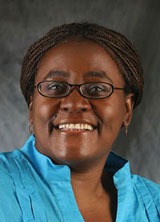
Reproduction technology allows people to produce children even after their own death. With the freezing and preserving of eggs or sperm, a biological ‘parent’ can have children well after they’ve died. In Graveside Birthday Parties: The Legal Consequences of Forming Families Posthumously, 60 Case W. Res. L. Rev. 1159 (2010), Professor Browne C. Lewis addresses the legal morass created when children are conceived posthumously, including: identification of the legal parents, whether the reproductive rights of deceased gamete providers have been improperly negated, and issues concerning the inheritance rights of posthumously conceived children. Professor Lewis highlights the importance, for children created posthumously, of identifying their legal parents. The law relies on the identification of legal parents in a number of important instances. For example, identification of the legal parents determines whether a child is ‘legitimate’ or ‘illegitimate,’ which effects financial support, inheritance under intestacy, collection of social security and other government benefits. Lewis also addresses the problem of protecting the reproductive rights of dead men. This section takes on the question of whether allowing posthumous conception interferes with the reproductive rights of the deceased gamete provider – that is whether conception denies the gamete provider the ability to decline to reproduce. Finally, Lewis looks at what she calls ‘laughing heirs’, that is, distant relatives who do not have a close connection with the deceased. She notes that a child born of posthumous reproduction could be a laughing heir. Further, for a man who dies intestate, the birth of a posthumous heir, sometimes many years after his own death, could impact the distribution of the estate. This further complicates the problems of identifying heirs and finalizing the distribution of estates. Lewis concludes that while scientists will continue to push the envelope on reproductive technology, legislatures and courts must keep up. They must continue to act to regulate the available technology, and unravel the legal issues those technologies leave behind for the children they’ve created.
 CSU Law Faculty