Chris Sagers, the James A. Thomas Professor of Law, spoke with The Atlantic for an article titled, “How Did America End Up With the Z.O.M.B.I.E. Act?” about the peculiar congressional habit of naming statutes with clever acronyms. The story was influenced in part by Sagers’ 2014 Georgetown Law Journal article on the same topic.
Category Archives: Faculty in the Media
Professor Mika Publishes on Teaching as a First Generation American
Professor Karin Mika has published an article titled “The Power of Vulnerability in Promoting a Sense of Belonging: The Perspective of a First Generation American.” The article appears in “The Second Draft,” a publication of the Legal Writing Institute. In the article, Professor Mika discusses how growing up as a child of immigrants affords the opportunity to better connect with students through assignments that foster communication and connection.
Professor Kalir Publishes Op-Ed on Affirmative Action
Professor Doron Kalir has published an op-ed titled, “The Supreme Court is poised to eliminate affirmative action,” on Cleveland.com.
Professor Robertson Presents at Pace Environmental Law Symposium
Professor Heidi Gorovitz Robertson participated in the Pace Environmental Law Review’s Fall 2022 Symposium on Environmental Constitutionalism. Her panel focused on Environmental Rights – Development and Design.
Robertson’s talk was titled Considerations for the crafting of subnational constitutional rights to a clean environment. It focused on her experience teaching an intersession course at the University of Maine School of Law during the period in which the Maine Legislature was considering whether to move a proposed environmental rights constitutional amendment to the voters. The course considered the environmental rights provisions in six U.S. state constitutions and compared their language and placement to Maine’s proposed environmental rights amendment – the Pine Tree Amendment. Robertson also worked with Maine legislators to understand the impact of other states’ environmental rights amendments on litigation rates, business, and other concerns. Although a majority of both houses of the Maine legislature supported the amendment, they did not do so with sufficient margins for the amendment to proceed to the voters.
The resulting article will be published next summer by the Pace Environmental Law Review. Robertson is the Steve W. Percy Professor of Law at C|M|LAW and Professor of Environmental Studies at the College of Education and Public Affairs.
Professor Laser Presents at University of Chicago Seminar
On Oct 17, Professor Christa Laser presented at a seminar at University of Chicago on legal issues in blockchain and web3. She discussed a work-in-progress paper that covers securities law, intellectual property law, and right of publicity issues for cryptocurrencies, NFTs, and other blockchain assets.
Professor Kalir featured in a Law360 Article on Record Sealing in Ohio
Professor Doron Kalir was recently quoted in Law360 about a recent Ohio Supreme Court decision involving record sealing.
The case, State ex rel. Cincinnati Enquirer v. Forsthoefel, involved the divorce records of three-time U.S. Senate candidate Josh Mandel. The Ohio Supreme Court held that judges must reason their opinions, and attorneys must provide strong evidence, in order for a sealing decision to stand.
The trial judge in the case had agreed to seal the records without reasoning. The parties who moved to seal the records provided no affidavits in support. Both were wrong, held the Supreme Court in reversing the decision.
Professor Kalir commented, “the rule is very clear that if and when a judge wants to overcome the presumption of a hearing and restrict public access, they have to do a lot of yeoman’s work.”
Professor Sterio Speaks at International Law Weekend
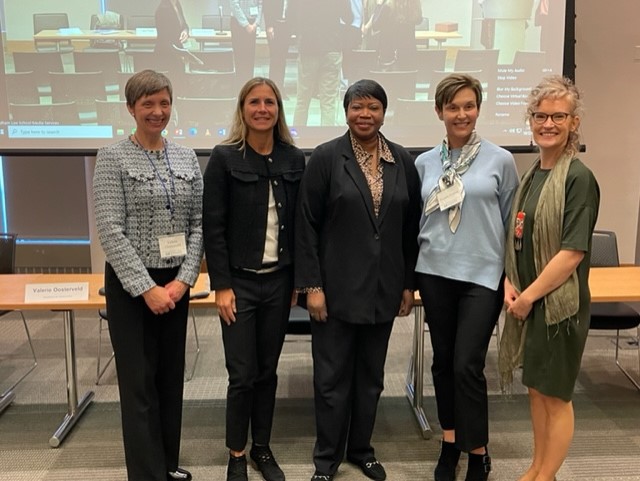
Professor Milena Sterio participated in International Law Weekend, a prestigious international law conference in New York City organized by the American Branch of the International Law Association. Professor Sterio serves on the Board of Directors of ABILA; in addition, she was a member of the organizing committee of ILW. At ILW, Professor Sterio moderated two panels. On October 22, she moderated a panel discussion on Racism and the Crime of Apartheid under International Law. On the same day, she also moderated a panel discussion on Prosecuting Sexual and Gender-Based Violence Crimes at the International Criminal Court. Professor Sterio had organized the latter panel.
Professor Sterio Speaks on Ukraine Conflict
Professor Milena Sterio moderated a panel on the topic of “Establishment of the Special Tribunal on the Crime of Aggression Against Ukraine: An Urgent Measure for Restauration of the Rule of Law” on October 21. The panel was organized by the Ukrainian Bar Association, the New York State Bar Association, and the Global Accountability Network.
Panelists included Anton Korynevich, Ukraine Ministry of Foreign Affairs; Oleksandr Kachura, Ukrainian Member of Parliament; Anna Ogrenchuk, President of the Ukrainian Bar Association; Sherry Levin Wallach, President of the NY State Bar Association; Jennifer Trahan, Professor at the NYU School of Global Affairs; David Crane; Former Chief Prosecutor at the Special Court for Sierra Leone; David Scheffer, Former Ambassador-at-Large for Global Criminal Justice, U.S. Department of State; and Irwin Cotler, Former Minister of Justice and Attorney General of Canada.
Professor Sterio also participated in an episode of the WCPN radio show “Talking Foreign Policy” about the Russia-Ukraine conflict. The episode was broadcast on WCPN on October 24 at 9:00 am and also at 9:00 p.m. The episode is also available on demand.
Professor Robertson Speaks in Ireland at Irish-American Law Conference
Professor Heidi Gorovitz Robertson travelled to Ireland with the Irish-American Law Society of Cleveland to participate in the group’s 2022 Law and Business Symposium. Events took place in both Dublin and Cork and included visits to The Honorable Society of King’s Inn, Four Courts of Dublin, Blackhall Place, Cork City Hall, and University College-Cork’s Center for Executive Education.
Robertson worked with Professor Owen McIntyre of UCC-Cork to plan and present a seminar on environmental law that included presenters on EU law, Irish law, and American law. Robertson and McIntyre were joined by Joanne Spalding, Acting Legal Director and Chief Climate Counsel for the Sierra Club’s Environmental Law Program, and Mr. Fred Logue, a prominent Irish environmental litigator. Robertson presented Systemic Issues in the U.S. Legal System Effecting Enforcement of US Climate Regulation. This talk followed Spalding’s presentation on the history of US climate litigation efforts and focused on the recent West Virginia v EPA case as well as Congress’ responses to that case in the Inflation Reduction Act. Following presentations on United Nations, European Union, and Irish approaches to human rights to a clean environment, she presented US Approaches to Environmental Rights: Focus on Sub-National and Local Initiatives.
Ohioans travelling to and participating in this event included many C|M|Law alumni including Ohio Supreme Court Chief Justice Maureen O’Connor, and Justices Melody Stewart and Michael Donnelly.
Robertson is the Steven W. Percy Professor of Law at C|M|Law and Professor of Environmental Studies at the College of Education and Public Affairs.
Katz Presents on Law School Teaching
Legal Educator-in-Residence Howard E. Katz made three presentations about law school teaching at the University of North Texas at Dallas College of Law on Sept 23. He conducted sessions on “Strategies and Techniques to Improve Our Teaching” and “Constructing and Grading Exams,” as well as a session specifically for those who teach first-year students.
 CSU Law Faculty