Professor Sterio Presents at AALS Annual Meeting; Is Elected Officer of International Law and International Human Rights Law Sections; Participates in United Nations Field Trip with Professor Majette

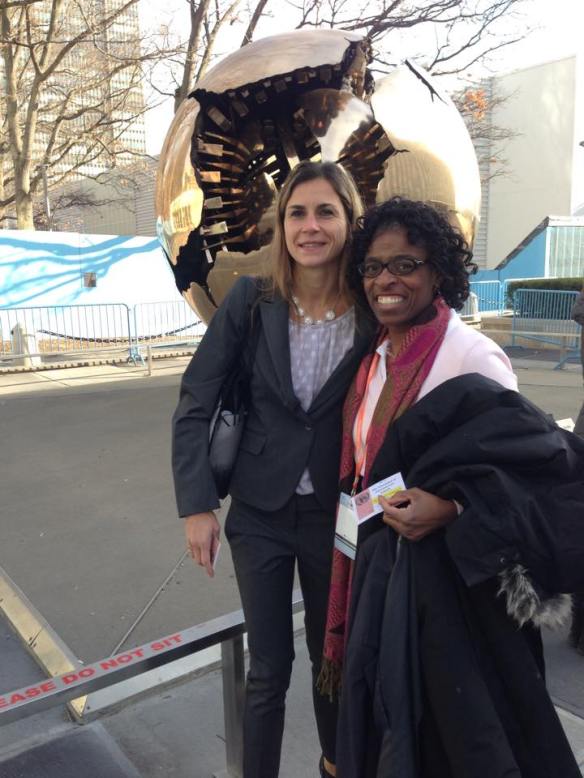
Professors Majette and Sterio

Professor Gwendolyn Majette (on the right) and Professor Milena Sterio, at the United Nations, during the 2016 AALS International Law Section Field Trip

Professor and Associate Dean Milena Sterio moderated a panel at the 2016 AALS Annual Meeting in New York City on January 8, entitled “Human Rights and Families.”  The program was organized by the AALS International Human Rights Law Section.  In addition, at the same conference, Professor Sterio spoke as a panelist at an AALS Discussion Group entitled “Increasing Author Diversity in Legal Scholarship: Individual and Institutional Strategies” on January 9.  Finally, Professor Sterio and Professor Gwendolyn Majette both participated in the AALS International Law Section field trip on January 7 to the United Nations building.


At the AALS Annual Meeting, Professor Sterio was elected Chair of the International Human Rights Law Section and Secretary of the International Law Section.

Professor Kalir Presents on the Relation between Spirituality and Politics

Clinical Professor of Law Doron Kalir was recently invited to St. Paul Church in Cleveland Heights to speak about the relation between spirituality and politics. His talk focused on Old Testament text and some founding American constitutional documents, which together – one hopes – may bridge the gap that currently exists between the two realms.

Professor Kalir Completes Six Lectures on the Philosophy of Jewish Faith

Doron Kalir

Clinical Professor Doron Kalir

Clinical Professor of Law Doron Kalir recently completed a six-lecture series on the philosophy of Jewish faith at Congregation B’nai-Jeshurun, one of the largest conservative synagogues at Cleveland. The series touched on the sources of the Jewish faith, its fundamental texts, and the tools it may provide for dealing with today’s world.

Professor Green Appointed to Executive Committee of AALS Section on Sexual Orientation and Gender Identity Issues

At the 2016 AALS Annual Meeting in New York City, Professor Matthew Green was appointed to the executive committee of the Section on Sexual Orientation and Gender Identity Issues.

Professor Mead Challenges Akron’s Anti-Panhandling Ordinance

Professor Mead has threatened a lawsuit against the City of Akron unless the City immediately repeals its anti-panhandling ordinance.  Under Akron’s ordinance, individuals who are soliciting donations are required to obtain a license from the City, are banned from asking for donations after dark, and are prohibited from soliciting in various public spaces throughout the city.  In a letter and supporting memorandum sent to the Mayor and City Council, available here, Professor Mead explains how these restrictions unconstitutionally discriminate against charitable solicitation and violate the First Amendment right to communicate one’s needs.

These arguments build on Professor Mead’s publication, The First Amendment Protection of Charitable Speech, which was published last year in the Ohio State Law Journal Furthermore.  Professor Mead has a joint appointment with the Maxine Goodman Levin College of Urban Affairs, and is handling this matter in connection with the ACLU of Ohio.

Professor Forte Participates in Drafting of Amici Curiae Brief and in Teleforum on The War on Terror

DavidFortePhoto

Professor David Forte

Professor David Forte participated in drafting an Amicus Brief for Amici Curiae Constitutional Law Scholars in Support of Petitioners in the case of Little Sisters of the Poor v. Burwell before the United States Supreme Court


On January 6, 2016, Professor Forte participated, along with Andrew McCarthy, Senior Fellow, National Review Institute, in a Teleforum sponsored by The Federalist Society on “The War on Terror: What’s in a Word?”

Professor Plecnik Elected Vice President and Chair of the Finance Committee at Willoughby Hills City Council

John Plecnik Swearing In

Professor John Plecnik at Swearing In Ceremony, with CM Alumnus, Judge Mark Bartolotta of the Lake County Probate Court

On January 4, Willoughby Hills City Council voted to elect Professor John Plecnik as Vice President and Chair of the Finance Committee.  More details about this position are available at Professor Plecnik’s website.  Professor Plecnik was recently re-elected to his second term as councilman at the Willoughby Hills City Council.  Professor Plecnik was sworn in by CM Law alumnus, Judge Mark Bartolotta of the Lake County Probate Court.

Professor Plecnik Quoted in Tax Notes Article

John Plecnik

Professor John Plecnik

Professor John Plecnik was quoted in an article in Tax Notes, published on December 28, 2015.  Professor Plecnik’s quotes are reproduced below:

Fraud, the standard for the 10-year ban, isn’t applied often — it’s a high standard with a strong definition, said John Plecnik of Cleveland State University’s Cleveland-Marshall College of Law. The issue is with the standard for reckless or intentional disregard of the rules, he said. The IRS treats that standard “like the Supreme Court treats pornography — we know it when we see it,” he said.

There are no regulations under section 32(k) defining the standard for recklessness or intentional disregard of the rules, case law is sparse, and the IRS has not issued any guidance on the point, Plecnik wrote in a 2014 Tax Notes article about the EITC ban (“Reckless Means Reckless: Understanding the EITC Ban,” Tax Notes, Feb. 24, 2014, p. 847 (Doc 2014-2409)).

“We have not essentially figured out as a tax bar how to apply 32(k) and its ban appropriately to the earned income tax credit,” Plecnik told Tax Analysts. “And to extend it to the child tax credit and the American opportunity tax credit before we’ve agreed on the definition of reckless — the standard of conduct that triggers the penalty — I think it’s irresponsible.”

Absent IRS action, the best option clinics and taxpayers have for challenging application of the bans and the definition of recklessness is in Tax Court, Plecnik said. He said he would want a clinic to file a regular case, not a small case, when making a challenge. There have been small cases on these issues, but not a regular case with all issues being raised to the court so that the judge on the case or the full court can address the really significant issue of when applying the ban is appropriate, he said.

A clinic could win a challenge based solely on legislative history of section 32(k) from 1997, Plecnik said. He said that based on that history, he believes Congress intended the same definition of reckless or intentional disregard in section 6662 to apply to section 32(k), which contains the EITC ban.

“I would be shocked if the Tax Court did not agree with the legislative history,” he said. “It’s a pretty clear-cut case.”

……………………………
Under the new law, the IRS will also have math error authority to use in reviewing returns of taxpayers who have been banned from claiming any of the three refundable credits for the length of the taxpayer’s ban, Plecnik said. While taxpayers can appeal an IRS determination to revise their return based on math error authority under section 6213, many low-income taxpayers don’t read or understand mail they get from the IRS, and so they may lose their 60-day appeal window, Plecnik said. In that case, he said, the only way they can get their money back is to sue for a refund, which requires them to pay the tax upfront. For many poorer taxpayers, that’s “functionally impossible,” he said.

“So many taxpayers are never even going to get to Tax Court, particularly because of this math error authority,” he said.
The full article is available here:  Tax Notes Today, 12.28.15, Plecnik


Together in the Struggle: Hands-On Learning through Research Labs | Claire Robinson May, Amy Burchfield & Brian Cassidy |

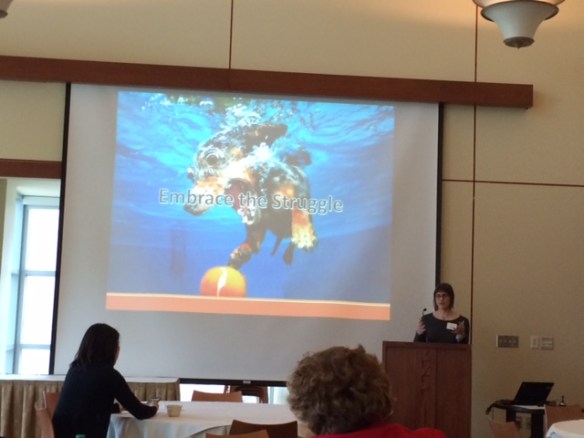
Professor Claire May presented jointly with Amy Burchfield and Brian Cassidy at the Legal Writing Institute 1-Day Workshop at Moritz College of Law at The Ohio State University on Friday, December 11. The conference theme was Collaboration In and Out of the Legal Writing Classroom.Claire May Presentation 1

According to Professor May, “In this session, we discuss our use of research labs to develop our students’ 21st century legal research skills. Our teaching group – two librarians and a legal writing professor – collaborates to identify needed legal research skills and then designs exercises to hone these skills. The lab sessions require students to sometimes struggle with a learning-by-doing approach towards the goal of gaining competency with research concepts and strategies. Students receive comprehensive feedback documents and ongoing encouragement. Our goal is to teach efficient and effective research in the current online research environment, rather than a traditional source by source methodology.”

Claire May 2

Professor Sterio’s Book Review Published by Melbourne Journal of International Law

Professor and Associate Dean Milena Sterio reviewed “Self-Determination and Secession in International Law” (edited by Christian Walter, Antje von Ungern-Sternberg and Kavus Abushov) (Oxford University Press 2014).  Professor Sterio’s book review was published by Melbourne Journal of International Law, in Issue 1, Volume 16 (2015).