An article critiquing the Supreme Court’s June 2015 decision in Reed v. Town of Gilbert co-authored by Alan Weinstein and Brian Connolly, a Denver-based attorney/planner, has been published in 47 Urb. Law 569 (2015). In their article, titled “Sign Regulation After Reed: Suggestions for Coping With Legal Uncertainty,” Weinstein and Connolly discuss the first amendment questions left unanswered by Reed, including whether that decisions “on its face” rule for determining whether a sign regulation is content-based applies to regulations that distinguish between commercial and non-commercial signs or between on-site and off-site signs. The article also discusses the effect Reed may — or may not — have on other first amendment issues, including the “secondary effects” doctrine and “speaker-based” regulations. The article concludes with suggestions for how local governments should revise their sign regulations to ensure compliance with Reed.
Author Archives: CSU|LAW
Professor Forte’s Recent Lectures and Debates
Professor David Forte has recently given the following lectures and engaged in the following debates:
“Is Chief Justice Roberts a Radical on Free Speech Rights?” Address to Forth Worth Federalist Lawyers’ Chapter, Forth Worth, Texas, March 3, 2016;
“SCOTUS Without Scalia,” Panel Discussion with Professor Michael Ariens, St. Mary’s Law School, San Antonio, Texas, March 2, 2016;
“Religious Liberty Today,” Debate with Professor Thomas Stacy, University of Kansas Law School, Lawrence, Kansas, March 1, 2016;
“Could Obergefell be the Worst Decision in the U.S. Supreme Court History?” Debate with Professor Gary Allison, University of Tulsa Law School, Tulsa, Oklahoma, February 29, 2016.
Professor Mika Presents at Workshop at University of Maryland School of Law and at Rocky Mountain Regional Legal Writing Workshop
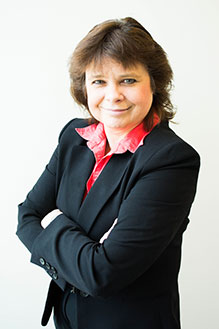
Professor Karin Mika
On March 11th, Professor Karin Mika was a facilitator for the ALWD sponsored Scholarship Workshop at the Capital Area Regional Legal Writing Workshop, held at the University of Maryland School of Law in Baltimore. On March 12th, Professor Mika presented on the topic of “Teaching Grammar to a New Generation of Learners.”
On March 19th, Professor Mika presented at the Rocky Mountain Regional Legal Writing Workshop, hosted by the University of Arizona Law School in Tucson. Her topic was “What Brain Games has taught me about teaching.” In her presentation, Professor Mika discussed the show “Brain Games,” on the National Geographic Channel, and how the show discussed certain features of how the brain acquires and retains information. Professor Mika focused on discussing learning where there are distractions, and how older and younger brains process information much differently. She used the examples from Brain Games to discuss how understanding younger brains helps in determining which teaching methods should best be used to reach our students.
Professor Daiker-Middaugh Selected as CSU 2016 Woman of Influence
Professor Pamela Daiker-Middaugh was selected as one of Cleveland State University’s 2016 Women of Influence. This award is given by the CSU Office of Inclusion and Multicultural Engagement, as part of the 2016 Women’s History Month Celebration. Professor Daiker-Middaugh (and other Women of Influence) will be honored at a luncheon on Tuesday, March 29, from 11:00 am – 1:00 pm, in the third floor Student Center Glasscock Family Ballroom.
Professor Weinstein Guest Speaks at National Webinar for Regulation of Sex Businesses
Alan Weinstein was the guest speaker for a national webinar on Regulation of Sex Businesses offered by the International Municipal Lawyers’ Association on Monday, March 14. Professor Weinstein discussed legal and practical concerns local governments face when regulating such businesses. Municipal attorneys from more than 90 cities participated in the webinar.
D.C. Circuit Quotes Professor Mead’s Article
The United States Court of Appeals for the District of Columbia Circuit wrestled with the question of which court has jurisdiction to review a federal agency decision, and found guidance in a law review article recently published by Joseph Mead, Assistant Professor. In its opinion, available at https://www.cadc.uscourts.gov/internet/opinions.nsf/279C5D8F82CF8ECC85257F7A004E02EC/$file/14-1240-1604600.pdf, the D.C. Circuit quoted from the article “Choosing a Court to Review the Executive,” which examines the complicated jurisdictional maze for challenges against federal agency decision. The article was co-authored with Nicholas Fromherz and published last year in the Administrative Law Review. The article has also been cited in the Yale Law Journal and the NYU Law Review.
Professor Plecnik Gives Guest Lecture at STEM School in Willoughby Hills
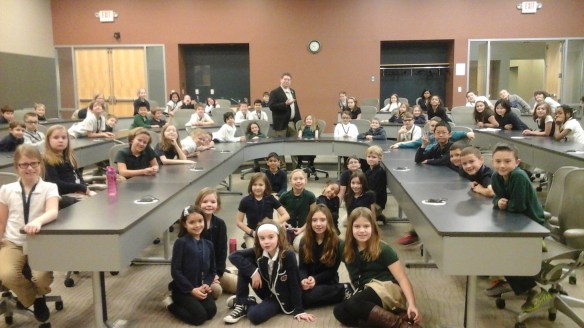
Professor John Plecnik and students at the Willoughby-Eastlake School of Innovation
On March 3, Professor John Plecnik gave a guest lecture on the role of local government in tax law and economic development to the students at the Willoughby-Eastlake School of Innovation in Willoughby Hills, which is a STEM school for gifted students.
Professors Emeritus Gelman and Finer Publish Opinion Piece on Filling Justice Scalia’s Supreme Court Seat
The Plain Dealer published today an opinion piece written by Professor Emeritus Sheldon Gelman and Professor Emeritus Joel Finer, entitled “Why not filling Antonin Scalia’s seat could work.” The piece is available here.
Professor Forte Presents at Orange County California Federalist Lawyers Chapter; Professor Forte’s Article Cited by Calabresi and Silverman
On February 11, 2016, Professor David Forte delivered an address to the Orange County California Federalist Lawyers Chapter entitled, “What would the Framers Have Thought of Today’s Supreme Court?”
In addition, Professor David Forte’s article, Lincoln, Marshall, and the Judicial Role, 1 Geo. J.L. & Pub. Pol’y 149 (2002) has been quoted and cited in Steven G. Calabresi & Bradley G. Silverman, Hayek and the Citation of Foreign Law: A Response to Professor Jeremy Waldron, 2015 Mich. St. L. Rev. 1, 158 n.1180.
Professor Weinstein Presents at Northeast Ohio Municipal Law Directors’ Association Law Seminar
On Thursday, February 25, Professor Alan Weinstein presented a one-hour CLE session titled “The First Amendment and Local Government: Ongoing Concerns/Recent Developments” at the Northeast Ohio Municipal Law Directors Association’s annual Presidents’ Day Municipal Law Seminar. Professor Weinstein discussed several topics, including: policies regarding prayer at public meetings after the Court’s 2014 ruling in Town of Greece v. Galloway; how lower courts are applying the Court’s 2015 ruling in Reed v. Town of Gilbert in challenges to sign regulations and panhandling/solicitation ordinances; updates on cases involving the Religious Land Use & Institutionalized Persons Act (RLUIPA) and regulation of adult entertainment businesses; and the public employee speech issues before the Court this term in Heffernan v. City of Paterson, N.J.
 CSU Law Faculty