Professor Roberston Participates in Environmental Law Scholars Workshop

Professor Heidi Gorovitz Robertson was honored to participate in Loyola University-Chicago’s Fifth Annual Environmental, Natural Resources, and Land Use Law Scholars Workshop, October 15 to 18, 2025, at Starved Rock State Park Lodge in Illinois.  This intensive scholarship workshop invites 10 scholars to workshop projects over three days at a state park lodge.  This year, in addition to Professor Robertson, invited participants included environmental/natural resources/land use law faculty from the law schools at the University of Michigan, University of Minnesota, Northwestern, McGeorge, Ohio State, Case Western Reserve, SMU, University of Richmond, and Loyola-Chicago.  Robertson workshopped her research on public involvement in energy development decision-making in Ohio.

Robertson is the Steven W. Percy Professor of Law at the College of Law and Professor of Environmental Studies at the Levin College of Public Affairs and Education, Cleveland State University.

Professor Oh Publishes on Discrimination Against Asian Americans

Professor Reginald Oh has published an article, “The Deferential Asian American: Low Racial Status and the Invisibility of Asian Americans in Leadership and the American Narrative,” in the St. John’s Law Review.

Professor Oh’s article puts forth a novel theory to explain why Asian Americans are systematically shut out of leadership positions in virtually all professional fields, including in the STEM and medical fields. He argues that Asian Americans are excluded from leadership because of perceived lack of “leadership qualities” due to their perceived low status, deferential or subservient racial character.

Professor Oh will be presenting the article at the St. John’s Law School in the spring, at an event sponsored by the St. John’s Law Review and the school’s Asian Pacific American Law Students Association.

The article citation is 99 St. John’s L. Rev. 107 (2025).

Professor Robertson Speaks on Public Voice in Administrative Law

Professor Heidi Gorovitz Robertson spoke on The Public Voice In Ohio Administrative Law, at the Ohio Environmental Council’s Conference on Environmental Law, held at The Ohio State University’s Moritz College of Law in Columbus on September 26, 2025.  Her presentation described the research behind her recent testimony before the Ohio Power Siting Board regarding the appropriate agency evaluation of public comments.  CSU College of Law Environmental Law Fellow Mark Bank presented on the same panel regarding his work on the data behind Professor Robertson’s testimony.

Robertson is the Steven W. Percy Professor of Law at the College of Law and Professor of Environmental Studies at the Levin College of Public Affairs and Education, Cleveland State University.

Professor Sterio Participates in International Law Weekend 

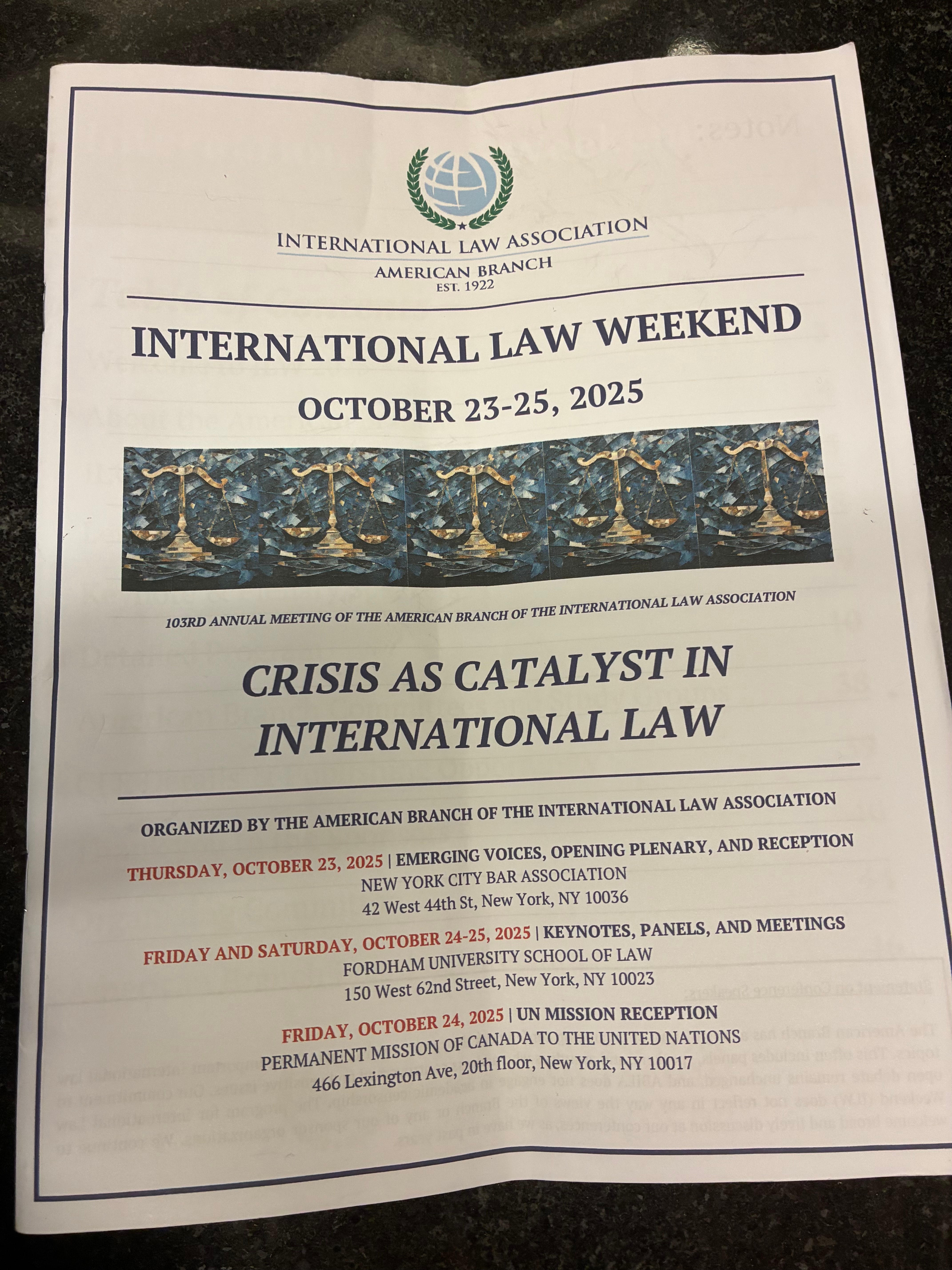
Professor Milena Sterio participated in the International Law Weekend conference in New York City from October 23-25.  International Law Weekend is a premier international law conference organized and hosted by the American Branch of the International Law Association (ABILA).  Professor Sterio serves on the ABILA Board of Directors; Co-Chairs the Gender Justice and the Teaching International Law Committees; serves as Co-Director of Studies; and also served on the ILW Organizing Committee this past year.  

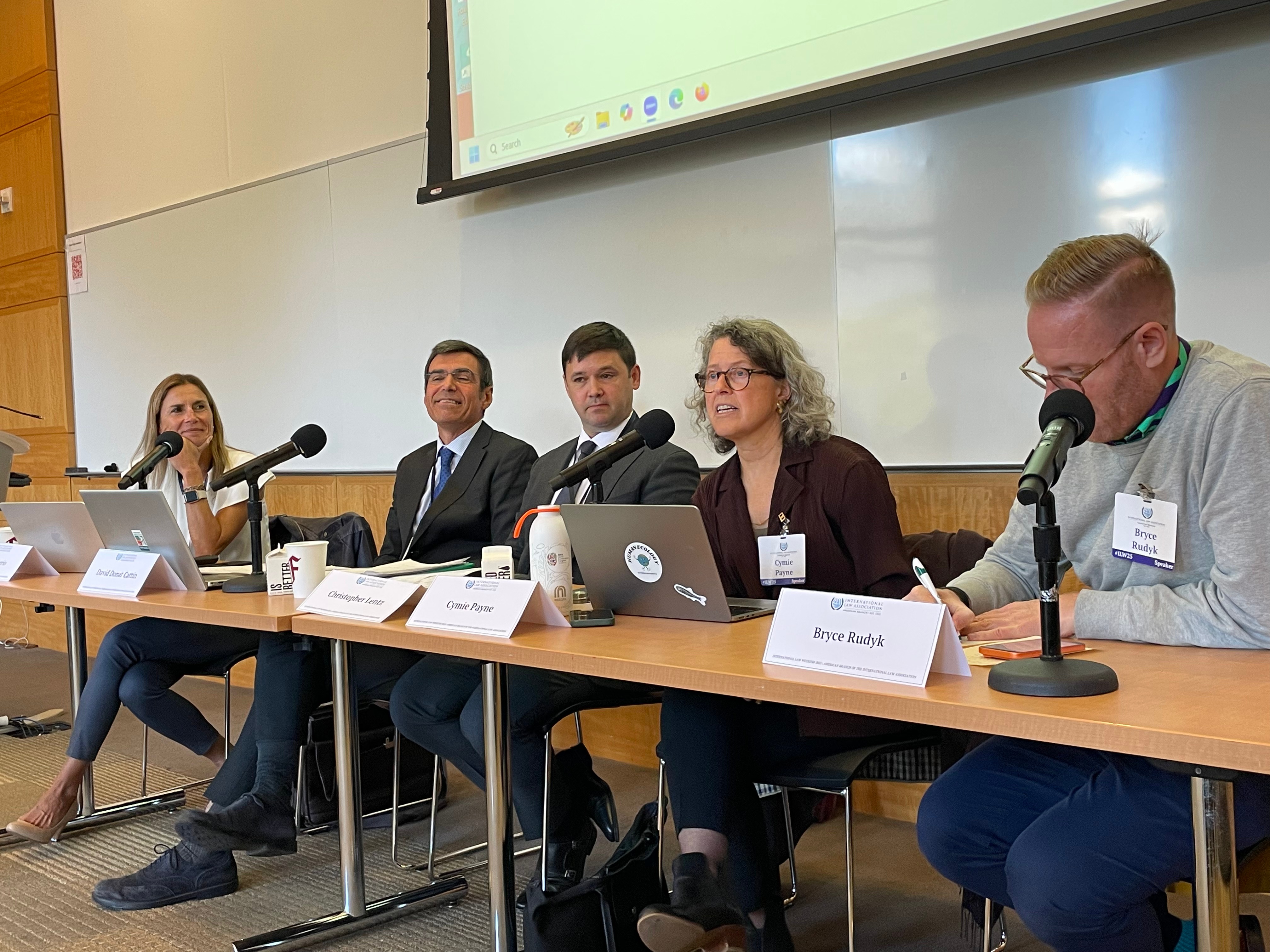
Professor Sterio (far left above) moderated a panel discussion on the topic of “Crimes Against the Environment, Nature, and Biodiversity – Progresses and Gaps in the Law of International and Transnational Crimes.” This panel was sponsored by the ABILA International Environmental Law Committee, and speakers included Prof. David Donat Cattin (NYU); Prof. Cymie Payne (Rutgers University School of Law); Christopher Lentz (Ukraine Register for Damages); and Bryce Rudyk (NYC and Legal Advisor to the Coalition of Small States).  Panelists explored progress and gaps within international environmental law, including ongoing civil and criminal cases and proceedings before international and regional tribunals.  

Professor Luisetto Presents at Conference on Empirical Legal Studies

Professor Lorenzo Luisetto presented his paper, “Collective Bargaining and Monopsony: The Regulation of Noncompete Agreements in France,” at the 19th Annual Conference on Empirical Legal Studies (CELS) hosted by Georgetown University Law Center on October 24-25, 2025. 

CELS is an interdisciplinary gathering that draws empirical researchers from across the United States and the world, bringing together scholars in law, economics, political science, psychology, and other fields who are interested in the empirical analysis of law and legal institutions. 

In his paper, Professor Luisetto examines how the regulation of noncompete agreements for employees through collective agreements affects firm-level markdowns in the French manufacturing sector. A key takeaway is that, by enhancing compliance or imposing additional requirements for noncompete enforceability, collective bargaining serves as an effective tool to regulate the use of noncompete agreements in France.

The working paper can be found here: https://cep.lse.ac.uk/pubs/download/dp2079.pdf

The full program of the conference can be found here: https://cels2025.com/

Professor Deborah Hoffman Presents at the 2025 Ohio Securities Conference

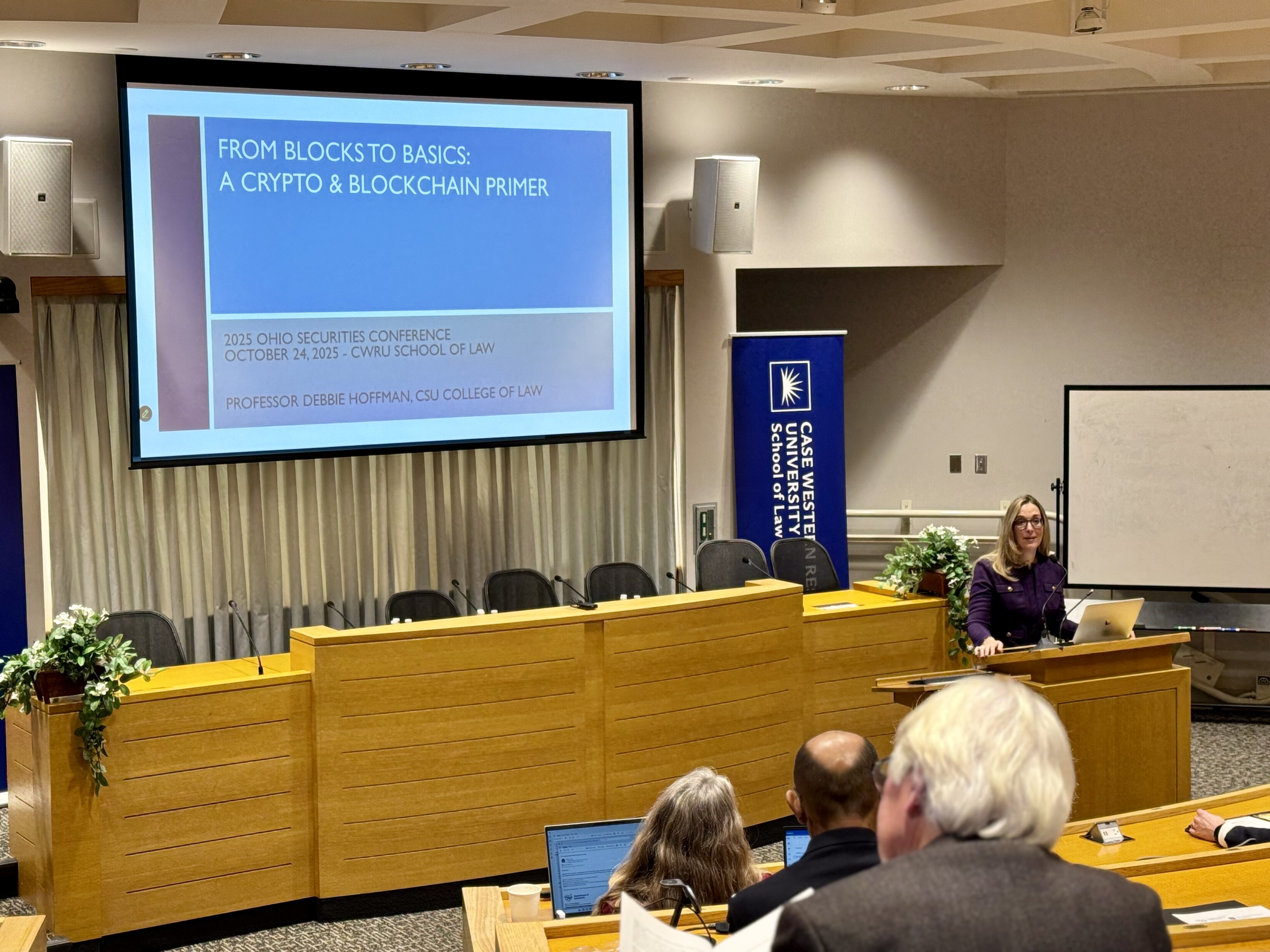
Professor Deborah Hoffman, Visiting Assistant Professor of Law at Cleveland State University College of Law, delivered the opening presentation at the 2025 Ohio Securities Conference on Oct. 24, 2025, co-hosted by the Ohio Department of Commerce Division of Securities and Case Western Reserve University School of Law. Her session, The State of the Blockchain provided an overview of blockchain and cryptocurrency fundamentals and examined how evolving digital-asset frameworks intersect with securities regulation.

Hoffman’s presentation launched a daylong program featuring regulators, industry leaders, and scholars exploring the legal and market implications of crypto innovation. Her remarks reflected ongoing scholarly work on blockchain regulation and her teaching at CSU Law in corporate law.

Professor Sterio Interviewed by Fox 5 News Channel 

Professor Sterio was interviewed by the Fox 5 News Channel on May 1, about the case of Kilmar Abrego Garcia, a Maryland-based man who has been wrongfully deported to El Salvador.  Professor Sterio’s interview is available here: https://youtu.be/AP4YyH_LxK8?si=BcsFASegWHdMdfM5

Professor Sterio Presents at the University of Cambridge

Professor Milena Sterio presented at a conference at the University of Cambridge on April 28-29.  The conference was organized by the Cambridge Journal of International Law on the topic of Navigating a Multipolar World: Challenges to the Post-WWII Status Quo of International Law. Professor Sterio presented on the topic of Artificial Intelligence and Individual Criminal Responsibility: A Paradox or a Possibility?.  Professor Sterio’s corresponding paper, on the same topic, will be published by the Cambridge Journal of International Law.

Professor Sterio Co-Hosts International Law Chats

International Law Chats is a podcast from the American Branch of the International Law Association (ABILA), hosted by Professor Chiara GiorgettiAlison Macdonald KC, and Professor Milena Sterio. Episodes air on the first Monday of every month and feature prominent guests in the field of international law. Episodes are available on Spotify, YouTube, and our website.

This month’s episode features Professor ⁠Gian Luca Burci⁠, Adjunct Professor of international law at the Graduate Institute of International and Development Studies, Geneva since 2012. He is also the Director of the joint LLM on Global Health Law and Governance between the Graduate Institute and Georgetown Law School, as well as Academic Adviser in the Global Health Centre of the Graduate Institute. Since 2016, Prof. Burci has been a Visiting Professor and Senior Scholar at the O’Neill Center on National and Global Health Law, Georgetown University School of Law. He shares his thoughts on the WHO global pandemic treaty and the future of global health law. 

Listen to Episode 2: Look WHOs Talking? below and subscribe to the podcast on Spotify and YouTube.

Professor Sterio Moderates ABILA Panel on Lack of Gender Parity in the International Judiciary

Professor Sterio moderated a panel on the topic of “The Right to Equal Participation in the Judiciary and the ICJ: Where are the Women?”  The panel was hosted by the American Branch of the International Law Association (ABILA), and co-sponsored by the American Society of International Law Women in International Law Interest Group, GQUAL, the Working Group for Gender Partiy for the International Court of Justice, and the Institute for African Women in the Law.  The panel was also the inaugural event for the new ABILA committee on Gender Justice, which Professor Sterio co-founded with Dr. Jessica Corsi. 

The panelists included Dr Jessica Corsi, Senior Law Lecturer at The City Law School at City St George’s, University of London; Prof. Margaret deGuzman, Temple University Beasley School of Law & Judge, International Residual Mechanism for Criminal Tribunals; Prof. Valerie Oosterveld, Western Law School (Canada) and Former ICC Advisor on Crimes Against Humanity; Prof. J. Jarpa Dawuni, Howard University; Corinne Detmeijer, Vice Chair of the CEDAW Committee to End Discrimination against Women; and Prof. Claudia Martin, American University Washington College of Law.  

The right to equal participation in decision making is a fundamental human right enshrined in international law, including in the International Covenant on Civil and Political Rights, the International Covenant on Economic Social, and Cultural Rights, and the Convention on the Elimination of All Forms of Discrimination against Women. In its General Recommendation 40 (GR40) issued in October 2024, the Committee on the Elimination of Discrimination Against Women (the CEDAW Committee) made it clear that this right applies to international judiciaries. GR40 notes that despite the fundamental nature of this right, States do not enforce it. The International Court of Justice (ICJ) is one such example. In the almost 80 years of the court, only 5.22% of its permanent judges have been women, the rest men, and no data is known regarding other genders. Justice systems should reflect the diversity of the societies they serve, and the ICJ is no exception. Known as the ‘World Court’, the historical and ongoing overrepresentation of one gender on its bench demonstrates its lack of representativeness. This panel discussion focused on the need for gender parity on the ICJ bench from a human rights lens with a special focus on the right to equal participation in decision making and in the international judiciary. Panelists discussed the causes and consequences of women’s absence from the ICJ bench and assessed barriers to ICJ judicial gender parity and how to overcome them. The discussion also addressed gender-based discrimination and gendered barriers to the fulfillment of other human rights that may impede the effective exercise of judicial participation rights for women. One year on from GR40, and one year away from the November 2026 ICJ judicial election, it is time to turn the recommendation into reality.  

The Panel recording is available here: https://www.youtube.com/watch?v=U5yeCXM0GNc