Professor Sterio Participates in International Law Events in NYC and Chautauqua

Professor Milena Sterio participated in an event at the United Nations in New York City on August 26 on the topic of “The ICJ Advisory Opinion on Climate Change and the BBNJ Agreement.” The BBNJ Agreement, also known as the Agreement on Marine Biological Diversity of Areas beyond National Jurisdiction, is an agreement under the United Nations Convention on the Law of the Sea.

Professor Sterio also participated in the International Humanitarian Law Roundtable on the topic of “The United Nations at 80 – Relevancy and Challenges for International Criminal Justice in the Coming Decades” in Chautauqua, New York, on August 24-25. 

Professor Sterio moderated a discussion group on “Facilitating the delivery of international criminal justice at the regional and national level.” This discussion group focused on prosecutions based on universal jurisdiction, the role of the investigative mechanisms, the creation of internationalized domestic tribunals (Syria), and the new Ukraine-Council of Europe aggression tribunal.
Adjunct Professor Meal Publishes on Negligence in Cyberattack Class Actions

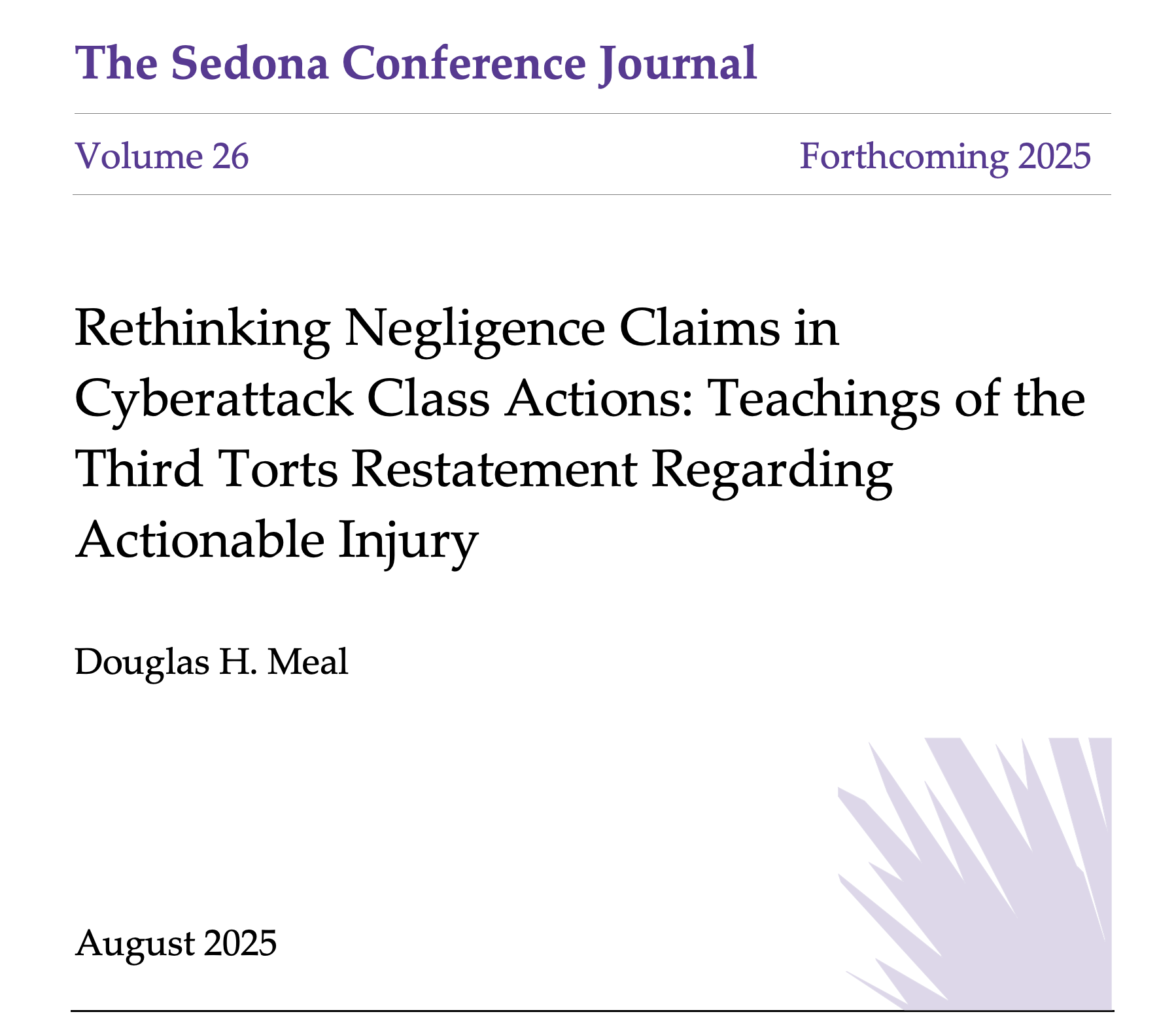
Douglas Meal, adjunct professor of law at CSU|LAW, has published an article titled “Rethinking Negligence Claims in Cyberattack Class Actions: Teachings of the Third Torts Restatement Regarding Actionable Injury.” The article was published in August 2025 in Volume 26 of the Sedona Conference Journal. The Sedona Conference is a nonprofit, nonpartisan think tank that convenes leading experts from the bench, bar, academia, and industry to discuss complex and emerging legal issues, including a Working Group on Data Security and Privacy Liability.

In the article, Professor Meal argues that US courts have to date failed to provide a coherent answer as to whether cyberattack class action members have suffered an “actionable injury.” Courts “have employed differing analytical frameworks, and arrived at disparate conclusions, regarding what sorts of cyberattack-caused injuries are actionable in negligence.” Drawing on the principles in the Third Restatement of Torts, he argues that “the injuries typically alleged in a cyberattack class action . . . [are] non-actionable in common-law negligence.” Accordingly, Professor Meal concludes that insofar as courts follow the Third Restatement of Torts, “in particular the series’ principles regarding actionable injury in common-law negligence, claims based on common-law negligence should, and will, cease to be viable in cyberattack class actions.”

As part of the CSU|LAW Center for Cybersecurity and Privacy Protection, three CSU law students — Kyndal N. Hutchison, Taneisha M. Fair, and Amanda Borngen — provided research assistance to Professor Meal for the article. Professor Meal teaches a course in Cybersecurity Litigation at CSU|LAW.

Professor Green Publishes on Supreme Court Title VII Case and DEI

Professor Matt Green has published an article in Attorney at Law Magazine titled “White Man’s Burden: Ames and the War on DEI.” In the article, Professor Green discusses the Supreme Court’s recent opinion in Ames v. Ohio Dep’t of Youth Services, which addressed the issue of “members of a majority group, say, white, heterosexual men, bear a heavier evidentiary burden to prove a claim of employment discrimination than members of a minority group.” In the Ames decision, Professor Green writes, “the U.S. Supreme Court held that burden is inconsistent with Title VII’s text and the Court’s precedent.”

Professor Green explains the relevant principles of Title VII at issue in the Ames decision, as well as analyzing the Court’s reversal of the Sixth Circuit. He also discusses the broader legal context, noting that the Ames decision may be used by opponents of DEI initiatives.

Professor Green then argues that “[d]espite the backlash, merely labeling a program as DEI does not mean it violates antidiscrimination laws,” in part because “DEI has no uniform meaning.”

Professor Green observes that “because Ames makes alleged reverse discrimination cases easier for plaintiffs to litigate, employers facing claims may opt to curtail or cancel DEI initiatives rather than risk prolonged, costly litigation even for claims that might ultimately fail on the merits.” 

Professor Robertson Serves as Fulbright Reviewer

Professor Heidi Gorovitz Robertson served as a reviewer for the Fulbright Commission’s Fulbright Specialist program in the 2025 Cycle 4 evaluations.  Robertson has served as a reviewer for applicants to the specialist roster for many years.  She is the Steven W. Percy Professor of Law at CSU|Law and Professor of Environmental Studies at the Levin College of Public Affairs and Education.

Professor Khan Joins Advisory Board for The Public Interest Corpus

Professor Mehtab Khan has been appointed to the Advisory Board of The Public Interest Corpus project, which is “focused on developing large-scale, high-quality AI training data from the world’s memory organizations to serve the public interest.” The Public Interest Corpus is a project of the Authors Alliance and Northeastern University with support from the Mellon Foundation. The Advisory Board includes leading national experts on AI, information science, and the role of libraries as information repositories.

Professor Khan Presents on AI at BIO Conference

On June 6, Professor Mehtab Khan spoke at the 2025 BIO Conference, held at the National Press Club in Washington, DC. Professor Khan was part of a panel titled, “The Next Phase of AI and Biography,” discussing how generative AI is changing “how biographies are researched, written, and safeguarded.”

Katz Presents on Law Teaching at SEALS Conference

Legal Educator-in-Residence Howard E. Katz made several presentations at the Southeast American Law Schools Association (SEALS) annual conference at Amelia Island, Florida.  On July 29, Prof. Katz was on a panel whose topic was “Designing Your Course Package”, as part of the Aspiring Law Teachers Workshop. He made two presentations as part of the Newer Law Teachers Workshop: on July 30 the topic was “Teaching Fundamentals: Designing an Effective Core Law School Course”; on July 31st the topic was “Constructing and Grading Exams to Enhance Assessment and Learning.”

Professor Sterio Presents on International Law Topics at SEALS Conference

Professor Milena Sterio presented at various discussion groups at the Southeast American Law Schools Association (SEALS) conference in Amelia Island, Florida.  On July 29, Prof. Sterio participated in the discussion group on “Current Trends in Emerging Technologies and the Law from the International, Comparative, and Domestic Perspective.”  On July 30, she participated in the discussion group on “Environmental Crimes in the Ukraine Conflict.”  And on August 2, she participated in the discussion group on “The Geneva Conventions: 75 Years Later.”

Professor Sterio Named to International Law and Foreign Affairs Committees

Professor Milena Sterio has been selected as a member of the International Law Association‘s newly established Rights of Nature Committee, as a representative of the American Branch of the International Law Association. In this capacity, Professor Sterio will collaborate with ILA colleagues on the development of the Committee’s inaugural report which will be issued in March 2025.

Professor Sterio also has been nominated and elected a member of the Cleveland Council on World Affairs for a three-year term starting in 2025. The CCWA was founded in 1923 to foster greater understanding of world affairs amongst citizens of Cleveland, with the notion that better international understanding would help promote world peace. Its mission is to promote engagement in international affairs and world cultures through education, citizen diplomacy and public dialogue.