Professor Heidi Gorovitz Robertson serves reguarly as a Peer Reviewer for the Fulbright Commission’s Fulbright Specialist program. Peer reviewers evaluate scholars and professional candidates for inclusion on the Fulbright Specialist Roster, from which Fulbright Specialists are drawn by host insitutions throughout the world. Robertson evaluates candidates in both law and urban affairs. She is the Steven W. Percy Distinguished Professor of Law at C|M|LAW and Professor of Environmental Studies at the Levin College of Urban Affairs.
Professor Sterio Receives Book Award, Presents at International Law Conference
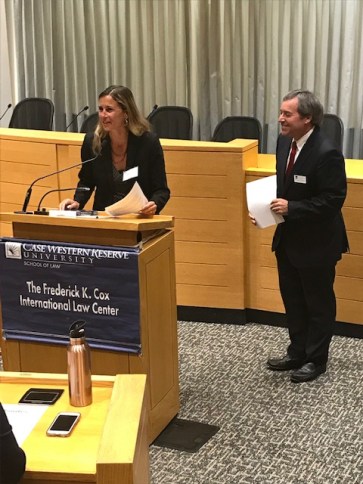 Professor Milena Sterio was awarded the Association Internationale de Droit Penal (International Association of Penal Law) 2019 Book Award, for “The Legacy of Ad Hoc Tribunals in International Criminal Law” (co-authored with Dean and Professor Michael Scharf) (Cambridge University Press 2019).
Professor Sterio also presented as a panelist at the “Atrocity Prevention: The Role of International Law and Justice” conference at Case Western Reserve University School of Law on September 20. Professor Sterio spoke on two panels: “Preventing Atrocities in Yemen” and “Threats and Challenges Confronting the International Criminal Court.”
Professor Sterio Talks Foreign Policy on WCPN
 Professor Milena Sterio participated in the taping of a radio show, “Talking Foreign Policy,” on 90.3/WCPN. This episode of the show focused on the Rohingya refugee crisis in Myanmar and featured Professor and Dean Michael Scharf, CWRU School of Law as host, and Professors Rebecca Hamilton and Paul Williams, Washington College of Law, American University, Attorney Jenny Domino, Satter Hunan Rights Fellow at Harvard Law School, and Ambassador Todd Buchwald, Woodrow Wilson Center. The episode will be broadcast on 90.3/WCPN on October 1 at 10:00 p.m.
Robertson appointed by ABA to Site Evaluation Team
Professor Heidi Gorovitz Robertson has been appointed by the American Bar Association to serve as the Academician on an ABA site evaluation team. In this capacity, Robertson will be responsible for evaluating the program of legal education and the faculty at the law school at the University of Nevada-Las Vegas in February 2020. The site evaluation team’s report will be submitted to the Accreditation Committee of the ABA Section on Legal Education and Admission to the Bar, which makes decisions on accreditation.
Robertson is the Steven W. Percy Professor of Law at C|M|LAW and a Professor Environmental Studies at the Levin College.
Professor Robertson Speaks at Fulbright Commission Webinar
Professor Heidi Gorovitz Robertson served as a panelist for the Fulbright Commission webinar on Fulbright Specialist grants. Robertson, an alumna of the program, discussed her two Fulbright Specialist grants — to Dr. Rom Manohar Lohiya National Law University in Lucknow, India, in 2014, and to Uppsala University in Uppsala, Sweden, in 2009.
The purpose of the webinar was to inform potential Fulbright Specialist candidates about the process for becoming a Fulbright Specialist and the benefits of doing so. For example, Robertson’s visit to Uppsala led to her appointment to the Common Core of European Law’s Property team, and then to visits to Italy, Spain, and back to Sweden. Her visit to Lucknow led to an invitation to visit the University of Petroleum and Energy Studies in Dehradun, India, in the foothills of the Himalayas.
The webinar was recorded. To access it, please contact Julie Good, Manager of International Programs at j.a.good88@csuohio.edu.
Professor Kalir Interviews on WURD Radio on Recent Israeli Election
On Thursday, Sept 18, Clinical Professor of Law Doron Kalir was interviewed by Charles Ellison on WURD Radio in Philadelphia. During the 20-minute interview, Professor Kalir discussed the recent (re-) elections in Israel and the many scenarios they may yield (there was no clear winner). He also discussed some of the similarities and differences between the Israeli and American election systems; compared PM Netanyahu’s campaign to that of President Trump’s; and discussed some post-election opportunities and challenges in the larger middle-east geo-political region.
This was Professor Kalir’s fifth appearance on the show.
Professor Sagers Speaks at Scalia School, Appears in Media on New Book
Chris Sagers, the James A. Thomas Professor of Law, has been busy traveling and speaking to promote his new book “United States v. Apple: Competition in America,” released this week by Harvard University Press. He spoke about it on Monday at the Antonin Scalia Law School of George Mason University, in a forum moderated by Professor and former Federal Trade Commissioner Josh Wright.
He spoke with Global Competition Review, a leading industry journal, for a long-form Q&A interview.
Professor Forte’s Constitution Day Essay, “Noble Sinners,” Published by Claremont Institute
In commemoration of Constitution Day, the Claremont Institute has just published an essay by Professor David Forte. In his essay, titled “Noble Sinners,” Professor Forte highlights the role that our Constitution played in holding the country together in its early fractious years. He explains how the drafters of the Constitution steadily evolved into bitter political rivals in the years following the country’s founding. Within a dozen years, “[t]he founding’s great lights had become openly contemptuous of one another. Political differences seemed impossible to bridge.”
Professor Forte argues that the country was able to survive these deep personal and political divisions among its leaders because the Constitution they had written “had already become an object of reverence,” serving as a “a fundamental charter that binds the people against themselves.”
The essay is based on a lecture Professor Forte delivered last year at Cleveland-Marshall, in the law school’s Constitution Day commemoration.
Professor Kalir Presents on Penitence, Kol-Nidrei
On Sept. 12, Professor Doron Kalir gave a presentation at Congregation B’nei Jeshurun about the meaning of atonement, penitence, and the prayer of Kol-Nidrei. The presentation was given as part of a lecture series in preparation for the Jewish High Holidays. It reviewed the origins, text, and purpose behind the most famous of Jewish prayers – the Kol Nidrei.
Professor Oh Presents and Publishes in Various Venues
Professor Reginald Oh:
- Spoke at the California Western School of Law’s Law Review symposium on immigrant rights last spring. He presented a paper entitled, Dehumanization, Immigrants, and Equal Protection. The article is forthcoming in the California Western Law Review.
- Is working on a chapter for the book, Critical Race Judgments. His chapter is a rewrite of the Supreme Court’s 1927 school segregation decision in Gong Lum v. Rice.
- Published an article, “The Supreme Court Post-Kavanaugh,” on The Loyal Opposition website. The article contends that one seat should be added to the Supreme Court to have ten justices sit on the Court.
- Published an article, “How We Should Think About Impeachment,” on The Loyal Opposition website. The article contends that the debate over impeaching President Trump should focus less on whether he has committed federal crimes and more on his fitness to wield executive power.
- Has been appointed to the Board of Directors for DemCast, a nonprofit organization engaging in social media political advocacy.

