On August 5, Professor Kevin O’Neill was a featured speaker on a nationwide webinar conducted by the American Bar Association titled, “The Future of Public Protest.” The webinar also featured the mayor of Savannah, Georgia and the police chief of Phoenix, Arizona. Professor O’Neill explained the case law governing the regulation of mass demonstrations and marches, and answered audience questions. The panel focused on the protest methods employed in the recent Black Lives Matter demonstrations that were ignited by the police killing of George Floyd.
Professor Robertson Serves as Fulbright Peer Reviewer
Professor Heidi Gorovitz Robertson served as a Peer Reviewer for the Fulbright Specialist Program’s 2020 Cycle 4 application process. Robertson has served as a peer reviewer for the Fulbright Specialist Program since 2017 and has received two Fulbright Specialist grants herself.
Robertson is the Steven W. Percy Distinguished Professor of Law at Cleveland-Marshall College of Law, and Professor of Environmental Studies at the Levin College of Urban Affairs.
Professor Sterio Hosts Book Launch
Professor Milena Sterio served as host and moderator of a book launch on July 23. The featured book was Professor Jennifer Trahan’s (NYU) “Existing Legal Limits to the Security Council Veto Power in the Face of Atrocity Crimes” (Cambridge University Press 2020). Panelists included Professor Trahan, Richard Goldstone (former Judge, South African Constitutional Court and former Prosecutor, International Criminal Tribunal for Yugoslavia and International Criminal Tribunal for Rwanda), Dean Michael Scharf (Case Western Reserve University School of Law), and Professor Beth Van Schaack (Stanford Law School).
Professor Sterio Presents at Feminist Legal Scholarship Series
Professor Milena Sterio presented her paper, “Women at the International Criminal Court,” at a session on July 22 of the Feminist Legal Scholarship series. The Feminist Legal Scholarship series is a bi-monthly workshop/presentation series; papers were selected from a competitive call-for-papers.
Professor Kalir Discusses Supreme Court Term on WURD Radio Philadelphia
On July 16, 2020, Clinical Professor of Law Doron Kalir was interviewed by Charles Ellison on WURD Radio Philadelphia on the recent Supreme Court Term. The conversation spanned various issues from Justice Ginsburg’s current health condition to Chief Justice Roberts’ move to the Court’s center, and from DACA, abortion rights, and LGBTQ’s recent opinions to the significance of federal judicial nominations. This has been Professor Kalir’s fourth appearance on the show.
Professor Robertson Publishes Article on Natural Gas Pipeline Routing
Professor Heidi Gorovitz Robertson has published Cities Seethe: A Case Study of Local Efforts to Influence Natural Gas Pipeline Routing Decisions, in the West Virginia Law Review. The article considers the efforts of local jurisdictions to influence the routing of a natural gas pipeline through Ohio. In particular, it evaluates the largely unsuccessful efforts of the City of Green, Ohio, to work with other jurisdictions and the judicial and administrative processes to move the Nexus/Spectra Energy pipeline away from Green to a less densely populated area. The article is available at 122 W. Va. L. Rev. 881 (2020), or here: https://papers.ssrn.com/sol3/papers.cfm?abstract_id=3652422
Robertson is the Steven W. Percy Distinguished Professor of Law at Cleveland-Marshall, and Professor of Environmental Studies at the Levin College of Urban Affairs, Cleveland State University.
Appellate Practice Clinic Secures Another Win in the Sixth Circuit Court of Appeals
The Appellate Practice Clinic has secured a victory for its client, Richard Lemoine, in the appeal of a habeas petition before the United States Court of Appeals for the Sixth Circuit. Lemoine was convicted for both receipt and possession of child pornography materials. In his Habeas motion before the District Court he argued several constitutional violations, which were all denied. The Sixth Circuit granted a Certificate of Appealability (COA) and appointed the Clinic to represent Lemoine on appeal.
In its Briefs, the Clinic argued that Lemoine’s convictions for both receipt and possession violated the Double-Jeopardy Clause. The Clinic also argued that Lemoine had the right to appeal his original conviction and failed to do so due to ineffective assistance of counsel. While the Sixth Circuit denied that right-to-appeal claim, it accepted in full the Double-Jeopardy claim and remanded the case for further consideration with the District Court. The court’s opinion is available here.
Students Gareth Kleiber and Jed Chedid (Clinic Fall 2019) and Halie Evans, Mara Hirtz, and Kelley Taurig (Clinic Spring 2020) worked on the Opening and the Reply Briefs, respectively. Clinical Professor Doron Kalir supervised the work and served as Attorney of Record.
Professor Ray Speaks on Privacy and Digital Contact Tracing
Professor Brian Ray participated in two recent webinars discussing the privacy issues raised by digital contact tracing applications. The first, in May, was hosted by The Ohio State University Moritz College of Law’s Program on Data Governance.
The second, on July 9, was titled “Health Surveillance, Privacy, and the Future of Democracy.” This program was part of the City Club of Cleveland’s “Happy Dog Takes on the World” series; a recording is available here.
Witmer-Rich Publishes Essay on Consent
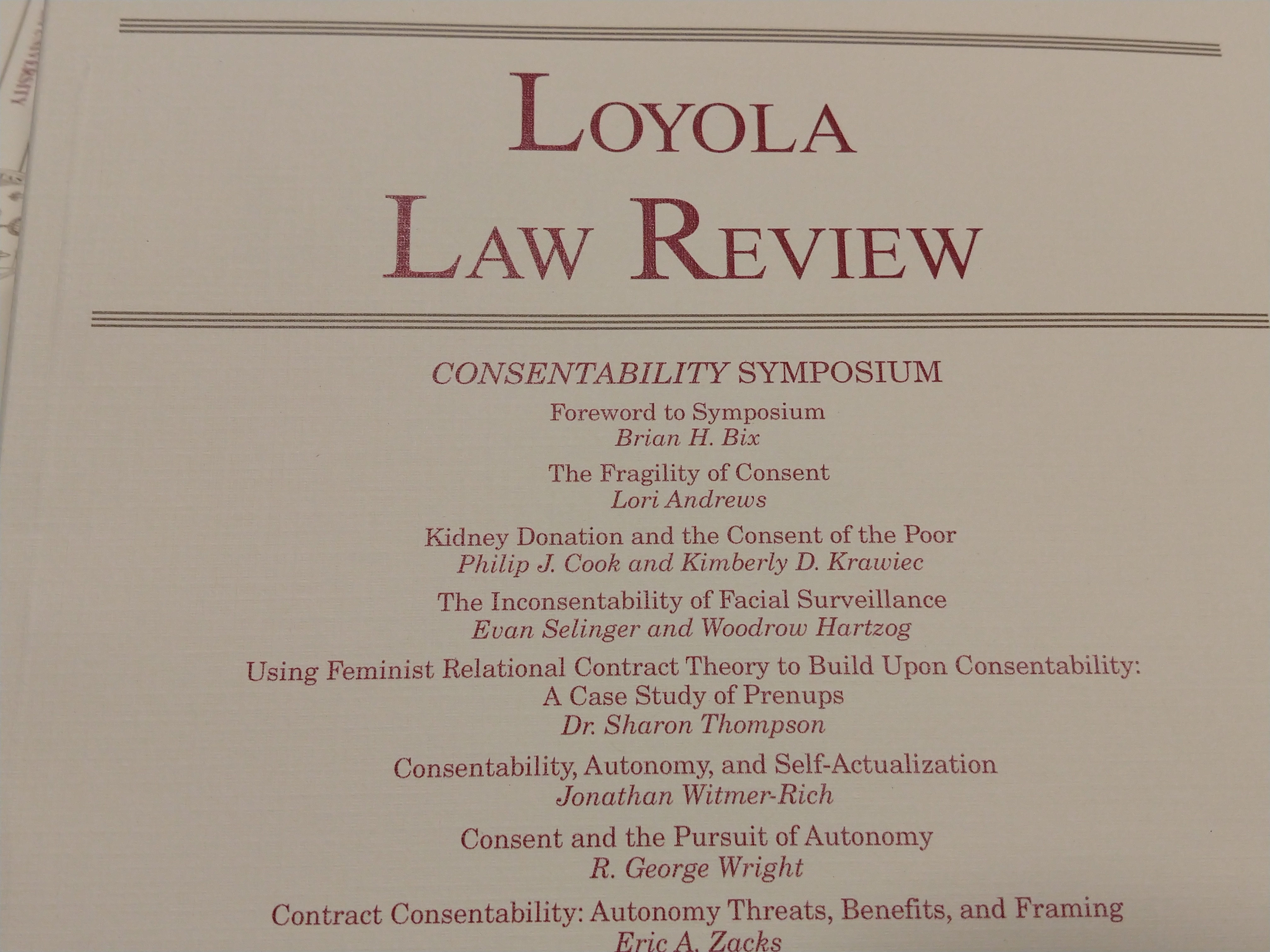
Professor Jonathan Witmer-Rich published an essay titled “Consentability, Autonomy, and Self-Actualization,” in the Loyola Law Review. This issue is devoted to a collection of invited essays responding to Professor Nancy S. Kim’s book, “Consentability: Consent and Its Limits,” recently published by Cambridge University Press. Other invited authors include Brian H. Bix (University of Minnesota), Philip J. Cook (Stanford University), and Kimberly D. Krawiec (Duke University), among others.
Professor Witmer-Rich’s essay evaluates several competing principles underlying consent, such as self-interest, self-sovereignty, and self-actualization. He argues that the nature of consent depends heavily on which of these underlying values consent is believed to serve. He concludes that “self-actualization–the ongoing human project of creating and embodying coherent and meaningful values and choices–is the most fundamental good of autonomy and is the good that society should seek to further in the law of consent.”
Professor Green Publishes Op-Ed on Bostock Decision
Professor Matthew W. Green Jr. published an op-ed today in Attorney-At-Law Magazine on the Supreme Court’s recent Bostock v. Clayton County decision. Bostock held that Title VII of the Civil Rights Act of 1964’s proscription against sex discrimination encompasses claims of sexual orientation and gender identity discrimination as well.
Professor Green lauded the Court’s opinion for several reasons. Prior to Bostock, LGBTQ individuals grappling with workplace discrimination faced a patchwork of protections that depended on geographic location. Most states, like Ohio, do not protect employees from discrimination on the basis of sexual orientation or gender identity. Bostock provides employees such protection as long as they work for an employer that falls within the scope of Title VII. Professor Green also notes the significance of Bostock in light of Obergefell v. Hodges, which barred states from prohibiting same-sex couples from marrying. Bostock makes Obergefell even more meaningful because employees no longer have to fear being fired for exercising their constitutional right to marry.
While Bostock is momentous, Professor Green explains that because the decision is limited to employment, LGBTQ individuals continue to lack important protections in other areas, such as public accommodations. Bostock also leaves several other issues unresolved. For these and other reasons, Professor Green argues that advocates should continue to push for legislation at the federal and state levels specifically addressing issues of importance to LGBTQ individuals.
Professor Green’s op-ed can be found here: https://attorneyatlawmagazine.com/bostock-welcome-respite-ongoing-battl
Professor Green is the Professor Alan Miles Ruben and Judge Betty Willis Ruben Professor at Cleveland-Marshall.
 CSU Law Faculty