
On March 8, Professor Doron Kalir presented before the Laura and Alvin Siegal Lifelong Learning Program at Case Western Reserve University. The title of the presentation was “Is Israel Losing its Democracy?” In it, Kalir reviewed Israel’s legal history, including its unique structure of Separation of Powers and lack of a binding Constitution. He then explained how the current Government, led by P.M. Netanyahu, aims to completely demolish the current structure — effectively bringing about a unitary, authoritarian regime that will eliminate, for all intent and purposes, Israel as a Democratic State. The presentation took ninety minutes and was very well received.
Professor Kalir Pens Op-Ed on The Imminent Danger to Israeli Democracy
On March 3, the Plain Dealer published Doron Kalir’s op-ed, titled, “Effort to muzzle judiciary poses imminent threat to Israel’s democracy.” The current Israeli Government, led by P.M. Netanyahu, is seeking to upend the current system of separation of powers and eliminate the independence of Israel’s judiciary. In response, a civil protest like never before has engulfed Israeli, with hundreds of thousands taking to the streets for months. The Op-Ed explains the scope of some of the most radical proposals — called by their proponents, in true Orwellian fashion, “judicial reform” — and then explains why they are so dangerous to Israel’s current, and very delicate, structure of government.
Professor Mika Presents on Teaching in the Post-Covid Era
Professor Karin Mika presented at the Rocky Mountain Legal Writing Conference at UNLV on February 25. Her presentation was titled, “Teaching Tips for a Post COVID Quarantine Generation of Students.” The presentation discussed the troubling trend of anxiety and disconnection in today’s law students and various ways that curriculum (and teaching) needed to modified in order to effectively teach current students.
Professor Mika Judges Writing Competitions
Professor Karin Mika recently served in various capacities judging writing competitions. She was a brief grader for the Capital Law School Child Welfare Law Moot Court Competition, an essay grader for the Maltz Museum’s “Stop the Hate” Essay Writing competition, and a reviewer for the Scribes Best Student Law Review Article Competition.
Professor Robertson Presents on European Law of the Commons
Professor Heidi Gorovitz Robertson presented “The Common Core of European Private Law: Meeting the Challenge of the Commons — the United States Report” at a lunch talk to faculty, staff, and students at the University of Maine School of Law (via Zoom) on February 15, 2023. The presentation described Professor Robertson’s experience as the United States Reporter (with Monica Epperson, St. Louis University) on the Access to Commons Working Group for the Common Core of European Private Law project — a 20+ year research project funded, in part, by the European Union. She discussed both the research process, which was unusual because it involved participation in the creation of a series of specific fact-based questions to be answered by national reporters, as well as the differences in global perspectives on commons.
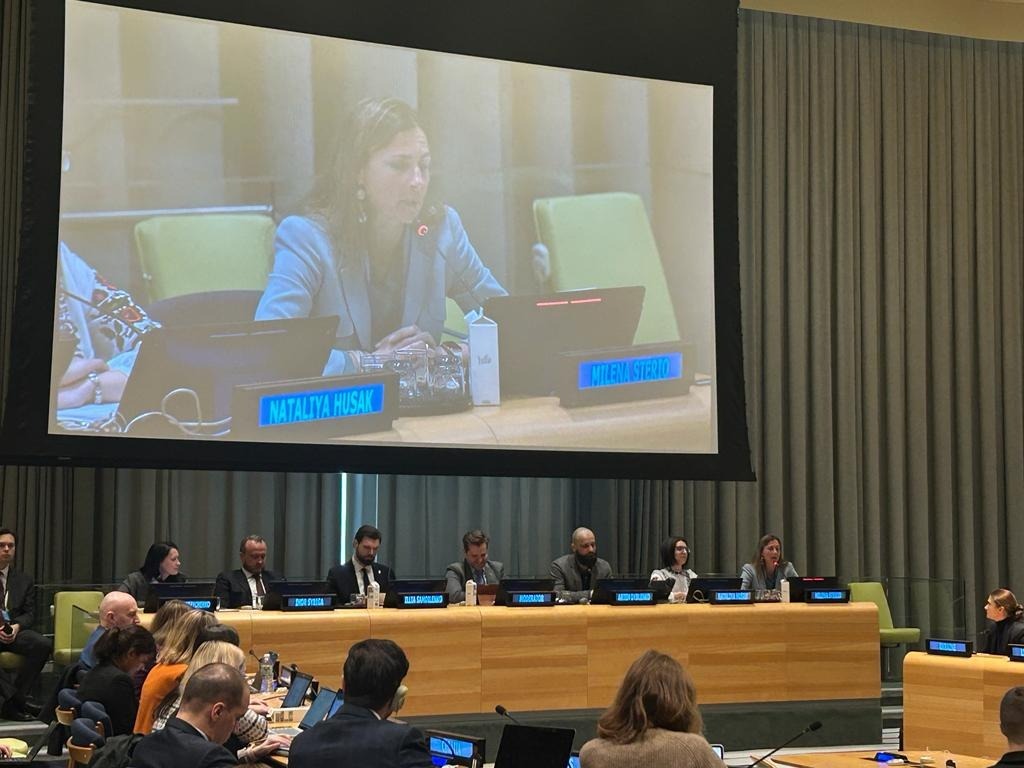
Professor Sterio Presents at UN on Human Rights Violations in Ukraine
Professor Milena Sterio presented at the United Nations in New York City, at a day-long conference on the topic of “Gross Human Rights Violations due to the Aggression Against Ukraine.” Professor Sterio delivered remarks on the topic of “The Rights of Prisoners of War under International Humanitarian Law.” Other presenters at the conference included The First Lady of Ukraine, Olena Zelenska (by video); Dmytro Kuleba, Foreign Minister of Ukraine; Karim Khan, Chief Prosecutor, International Criminal Court; Linda Thomas-Greenfield, US Ambassador to the United Nations; and Melanie Joly, Foreign Minister of Canada.
Appellate Clinic Secures Another Win (Its Sixth) in the Sixth Circuit Court of Appeals
Teddy Norris is a federal prisoner. In 2016 he filed, and won, a motion to vacate his sentence under Section 2255. Last year, representing himself, he wanted to file again. Believing that his subsequent motion was “second or successive,” he filed it first with the Sixth Circuit Court of Appeals, seeking permission to do so.
The Court appointed the Appellate Practice Clinic to answer the question of whether this subsequent motion was, indeed, “second or successive.” The Clinic argued it was not.
Three students — Oluwatoni Kolawole, Jeffrey Andrews, and Mickey Isakoff — wrote an exceptional brief. The students exhaustively researched every case ever decided in this area, and they developed a novel theory regarding the Court’s jurisdiction on the issue. The students argued that this subsequent motion was not “second or successive,” and therefore that Norris could — and should — refile it in District Court without a need to ask leave from the Court of Appeals.
The Government, in its response, agreed with every word.
Thus, without a real “case or controversy,” the Sixth Circuit agreed with the Clinic in full. The Court held that the motion was not “second or successive,” and thus did not require authorization. The Court then transferred the case to the District Court.
Professor Doron Kalir supervised the work and served as Counsel of Record.
Professor Sterio Publishes Blog Post on US Support for ICC Victim Trust Fund
Professor Milena Sterio published a blog post on Just Security, a prominent international law-focused blog, on the topic of the possibility of the U.S. contribution to the International Criminal Court’s Trust Fund for Victims. Professor Sterio’s post (co-authored with Professor Yvonne Dutton) is part of a Symposium titled “U.S. Support for the ICC’s Trust Fund for Victims.” Professor Sterio and Professor Dutton’s co-authored piece is titled, “The United States Can and Should Broadly Contribute to the Trust Fund for Victims.”
CSU Law Cybersecurity Program Featured on Bloomberg Law
CSU Law’s Cybersecurity programs were featured in an article in Bloomberg’s “Law School Innovation Program,” in an article titled, “How Innovative Law Schools Foster Student Development.” The article highlights CSU Law’s Cybersecurity and Data Privacy certificate program, as well as the Masters of Legal Studies in Cybersecurity and Data Privacy. The article notes that CSU’s programs “provide students the chance to acquire mastery of the technical aspects of cybersecurity and to work together with students from other disciplines on real-life situations where the legal and technical issues intersect.”
The article quotes Professor Brian Ray, Director of CSU Law’s Center for Cybersecurity and Privacy Protection. Professor Ray explains, “Our faculty and staff are constantly working to develop new programs and identify outside opportunities for our students to develop skills and engage in experiences to prepare them for existing and new careers in law and law-related fields.”
Professor Chien Publishes Article on Cultural Change in Prosecutor Offices
Professor Shih-Chun “Steven” Chien has published an article in the Minnesota Journal of International Law titled, “Cultivating Sense: Cultural Change in the Prosecutor’s Office.”
Professor Chien’s article constructs a new paradigm for the understanding of cultural change within prosecutors’ offices. It reveals a troublesome paradox about modern prosecutorial power. The article argues that to transform organizational culture, prosecutors need to forge a new type of power based on their “sense-making authority.” Meanwhile, the same power enables prosecutors to create an opaque process that bypasses organizational structure and reduces external accountability. To build the theory of cultural change, Professor Chien relies on a comparative case-study approach based on ethnographic research. Professor Chien conducted extensive research on site at a group of district attorneys’ offices led by “progressive prosecutors” across the United States and a district prosecutor’s office located in a metropolitan area of Taiwan.
Professor Chien proposes a contested cultural change model and explores ways in which the model could contribute much-needed theoretical and strategic groundings to the comparative study of prosecutorial reforms across different jurisdictions.
 CSU Law Faculty