Legal Educator in Residence Howard E. Katz made three presentations at the Southeast Association of Law Schools (SEALS) Annual Conference in Boca Raton, Fl, held from July 22 through July 29. He spoke about Designing an Effective Core Law School Course, as part of the Newer Law Professors Workshop. Howard also participated in a discussion group on Teaching Torts, and a discussion group on Making Sense of Teaching Evaluations and Faculty-Student Interaction.
Legal Educator in Residence Katz Presents at Leading Edge
Legal Educator in Residence Howard E. Katz made two presentations at the Ninth Annual Aspen Publishing Leading Edge Conference, held at the MIT Endicott House in Dedham, Massachusetts on July 10-12. The invitation-only conference brought together thirty-two thought leaders to discuss topics relevant to the future of legal education. Howard led two discussions. One session was on “(re)Designing the Curriculum (Especially the First Year) to Accomplish More/Other Things (and to Create Opportunity for Different Students to Thrive.” The other session, which Howard led along with Dean Michael Barry of South Texas School of Law, addressed the preparation students have or don’t have when entering law school, and ways of helping students, once they are admitted and enrolled, who do not have access to the unwritten rules of how to do law school.
Legal Educator in Residence Katz Presents at AALS
Legal Educator in Residence Howard E. Katz made two presentations at the annual AALS Workshop for New Law Teachers held June 8-10 in Washington, D.C. One was on teaching methods: Inside the Classroom. The other was the concluding plenary session: Keeping It All Together. He also facilitated two group discussions. Howard has made presentations on teaching to new professors at this conference the last six times it was held. The book Strategies and Techniques of Law School Teaching, which he co-authored with Professor Kevin F. O’Neill, was given to attendees, as were copies of books from the Strategies and Techniques series (edited by Professor Katz) that provide subject-specific teaching advice.
Professor Robertson Peer Reviewer for Fulbright Specialists
Professor Heidi Gorovitz Robertson served as a peer reviewer for applicants to the Fulbright Commission’s Fulbright Specialists program roster for the 2023 Cycle 4 application process. Since 2017, Robertson has been a peer reviewer for several application cycles annually in the fields of law, environmental studies, and environmental science. Robertson has completed two Fulbright Specialist grants herself — one to Uppsala University in Uppsala, Sweden, the other to Dr. Ram Manohar Lohiya National Law University in Lucknow, India. Robertson is the Steven W. Percy Professor of Law and holds a dual appointment in environmental studies at the Levin College of Public Affairs and Education.
Global Space Law Center on YouTube
Professor Laser to Present on Blockchain IP
Professor Laser will present her work-in-progress Legal Issues in Blockchain, Cryptocurrency, and Non-Fungible Tokens at the Junior Intellectual Property Scholars Conference and the Intellectual Property Scholars Conference in August.
Professor Laser Posts on Generative AI Law
Professor Kalir Pens Op-Ed Criticizing SCOTUS’ “Creative 303” Opinion
On Friday, July 7, Professor Doron Kalir published an op-ed in the Cleveland Plain Dealer, criticizing the Supreme Court’s recent “Creative 303” opinion. That opinion, Professor Kalir explains, effectively allows — for the first time in the Court’s history — a service provider in the open market to discriminate against its clients on the basis of their sexual discrimination. Provocatively titled “No Jews or LGBTQ Allowed? The Supreme Court Seems to Agree,” the op-ed criticizes the Court’s decision as another conservative super-majority unnecessary result. Widely citing Justice Sotomayor’s dissent, the op-ed claims that the Court reached that conclusion only by asking the wrong question. In addition, the opinion argues that once the Petitioner chose, on her own volition, to participate in the order marketplace, she had to abide by the rules of that marketplace — which prohibits discrimination of any kind, and have done so for over 300 years — rather than to ask a conservative super-majority to change those rules for her and allow from now on a discrimination sanctioned by the highest court in the land.
Appellate Practice Clinic Travels to Sixth Circuit Court of Appeals
On June 14, the CSU Law Appellate Practice Clinic went to Cincinnati to conduct an oral argument before the Sixth Circuit Court of Appeals.
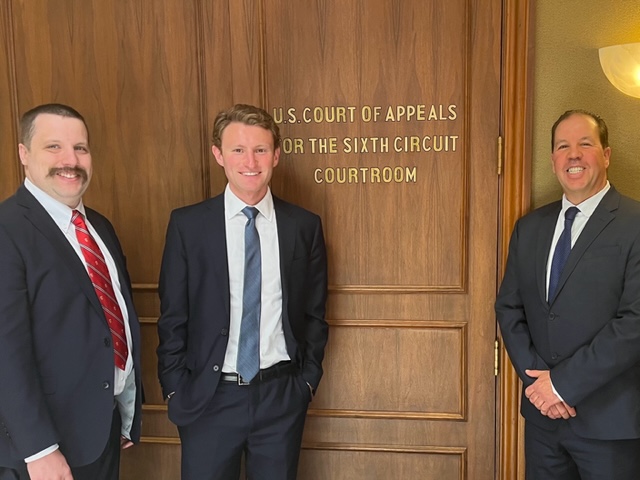
The Clinic’s team included students Philip Shipman ’24 (left), Mickey Isakoff ’24 (center), and Professor Kalir (right), who directs the Clinic and served as counsel of record.
The three met prior to the hearing for a last-minute polish of the argument; walked together to the Federal Courthouse early in the day; and attended Oral Argument in the case they worked on (delivered by Professor Kalir) before a panel of Chief Judge Sutton, and Judges Larson and Murphy. Finally, the team conducted a post-hearing debrief, much like they would later do in their career.
Mr. Shipman stated, “This was my first time in a Federal Appeals Court, and I could feel the history permeating the courtroom. I cannot describe how incredible the experience was, and I challenge all students and alumni to attend an oral argument in the Sixth Circuit Court of Appeals. I am grateful for the opportunity to participate in the brief writing process and am thankful to the College of Law for supporting the Appellate Practice Clinic.”
Mr. Isakoff added, “For me, the entire experience may be summed up as inspirational. The aura and respect for the tribunal was palpable. And the level of preparation commanded by the judges and demonstrated by the oralists was remarkable—truly demonstrating what it means to be a professional attorney. It was the pinnacle of what being an aspiring attorney and experiential learning is all about.”
Other than these two students, no less than six other students from the Clinic were involved in this case — from the opening brief, to reply brief, to oral argument preparation — including Ms. Dalya Oprian, Ms. Tigan Woolson, Mr. Tony Zarrella, Ms. Abby McCoy, Mr. Dylan Brown, and Mr. Joe Stebelton. Professors Jonathan Witmer-Rich, Matthew Green, and Joe Mead graciously assisted in the preparation for the oral argument.
“This was, no doubt, a culmination of a very long process,” said Professor Kalir. “This is one of the most complex cases we had in the Clinic, and I’m truly happy that the students had such a great opportunity to be immersed in it. More personally, it was a true honor for me to finally argue before the Chief Judge, who is truly a brilliant jurist, as well as before (former Michigan Law Professor) Judge Larson and (former Ohio Solicitor General) Judge Murphy. What an amazing panel.”
The opinion in the case will be rendered in the coming months.
Professor Sterio Discusses, Writes on International Law Enforcement, Gender Perseution
Professor Milena Sterio participated as a panelist at a conference at Rutgers Law School, on the topic of “Enforcement of International Criminal Law,” on May 14-15.
Professor Sterio also moderated a webinar on the topic of “Dusting Off the Law Books on Gender Persecution: Why a Policy on the Crime against Humanity of Gender Persecution” on May 26. The event recording is available here.
Professor Sterio contributed a blog post, co-authored with Professor Yvonne Dutton, on the topic of “The ICC’s 2022 Gender Persecution Policy in Context: An Important Next Step Forward” to Just Security, one of the most prominent international law blogs.
 CSU Law Faculty