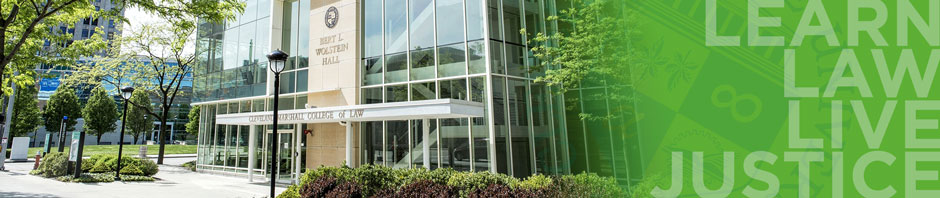
Dean Craig Boise appeared on WCPN’s radio show ‘The Sound of Ideas’ on Monday, August 29th. Along with the Dean Lawrence Mitchell from Case, Dean Boise discussed the many strengths of C|M|LAW, our faculty, and our graduates, emphasizing our interconnection with the Cleveland legal community and our growing national reach. You can listen to the program at http://www.ideastream.org/soi/entry/42077.
Category Archives: Faculty News
Sagers Signs US Supreme Court Amicus Brief on Antitrust Matter
Professor Chris Sagers has signed an amicus brief submitted to the U.S. Supreme Court by a group of antitrust professors and scholars in Hosanna-Tabor Evangelical Lutheran Church and School v. Equal Employment Opportunity Commission. In this brief, the professors argue that the ministerial exception does not and should not be expanded to protect professional associations of clergy from antitrust scrutiny. They argue that a broadly or loosely defined ‘ministerial exception’ could allow clergy to form agreements that would otherwise be condemned under the Sherman Act. In particular, the group is concerned that certain professional organizations of clergy organize their labor markets through restraints that, absent First Amendment projections, would violate the Sherman Act, and that the ‘ministerial exception’ was not intended to facilitate or immunize such actions. They argue that the ministerial exception was intended to apply to hierarchical religious organizations to avoid government intrusion into matters regarding employment of their clergy. It was not intended to apply to all matters of employment, such as the employment rules imposed by professional associations and those imposed by independent congregations.
To read the brief, click here:
https://www2.law.csuohio.edu/newsevents/images/HosannaTaborAmicus.pdf
Inniss Named Fellow of the Centre National de la Recherche Scientifique-New York University Memory Project
Professor Lolita Buckner Inniss has been named a fellow of the Centre National de la Recherche Scientifique (CNRS-France)-New York University (NYU- U.S.) Memory Project. In 2011-2012, she will participate in a research project on the topic of “Memory and Memorialization: Representing Trauma and War.” Professor Inniss was selected for this project based on a portion of her larger project titled “The Princeton Fugitive Slave Case: Jimmy the College Apple Man and Memories of Slavery.” Her larger project is a legal history of slavery in New Jersey. That project is framed around the life and fugitive slave trial of an escaped slave employed by Princeton University in the 1800s. In her work with CNRS-NYU, she will address, among other things, memories of the trial and of the state and federal laws under which the trial was conducted.
The Memory Project brings together academic and legal experts and researchers on memory in its historical, socio-cultural and neurological manifestations. The program cuts across a variety of disciplines in the humanities, social sciences, biological, and cognitive sciences. One of the program’s chief goals is to create a formal, ongoing platform for exchanges across national, professional and disciplinary boundaries.
Professor Inniss’ participation in this program will include travel to France for a 1 to 2 month period between October and May this academic year. Fellows from France will travel to New York for a similar period.
Steinglass Advocates for the Ohio Constitutional Modernization Commission to Review and Revise the Ohio Constitution
Dean Emeritus Steven Steinglass has been active in the effort to create an Ohio Constitutional Modernization Commission as a means to review and revise Ohio’s constitution . He published, today, an Op-Ed in the Columbus Dispatch entitled Constitutional Commission is the Way to Go. The Op-Ed provides a history of the Ohio constitutional amendment processes and advocates for a new approach to constitutional revision. He urges voters to reject the option of a Constitutional Convention, which will appear on the ballot in November 2012. Instead, the new approach, supported by a broad, bi-partisan coalition, would allow a bi-partisan commission to review the constitution and propose changes to the legislature. The commission includes 12 legislators – six from each house divided equally between Republicans and Democrats – and 20 non-legislators selected by the legislative members. It may make recommendations to the General Assembly only by a two-thirds vote. Steinglass argues that the commission approach is well suited to facing the complex and divisive issues that will undoubtedly arise, and that the nature of the commission and approval process will ensure that only broadly supportable proposals will emerge.
To read Dean Steinglass’ Op-Ed, please click here. http://www.dispatch.com/live/content/editorials/stories/2011/07/27/constitutional-commission-is-the-way-to-go.html?sid=101
Dean Steinglass was also inverviewed on National Public Radio regarding the Constitutional Modernization Commission. Please click here for a link to the June 24 interview. Interview of Steven H. Steinglass on the Constitutional Modernization Commission and Call for a 2012 Constitutional Convention – Ideastream, WVIZ-PBS. The interview starts 16 minutes into the video, at 16:05. http://www.ideastream.org/ohio/entry/41029
Hoke to Participate in Panel Discussion at Republican National Lawyers Association Election Law Seminar
On Friday, August 12, Professor Candice Hoke will participate in the Republican National Lawyers Association’s Election Law Seminar in Cincinnati, Ohio. The panel will address”Electoral Reform: Registration and Ballots for Military, Overseas, Student and Other Voters.” Professor Hoke will discuss, in particular, The Threats Posed by Internet Voting.
C|M|LAW Receives Ohio Senate Commendation for the 2010 Diversity Matters Award
Forte Publishes Originalism in the Classroom
Professor David Forte has published Originalism in the Classroom in the current issue of Academic Questions. In this article, Forte evaluates the way we have taught law in the twenty-five years since Attorney General Edwin Meese’s plea to return to “a Jurisprudence of Original Intention.” Forte begins by looking at several US Supreme Court cases in the areas of church-state relations, 14th amendment Due Process, and abortion. It is through these cases, he argues, that the Court reawakened ideas of originalism. Following these cases, Forte writes, originalism became a legitimate and principled method of constitutional interpretation. Following Meese’s speech, he asserts, originalism became the most principled form of constitutional analysis.
Forte next addresses the impact of originalism, arguing that substantial research has been done on the topic since the Court and Meese reintroduced and even championed it as a principled method of constitutional analysis. That research has provided this generation of lawyers with a new and deeper outlook on the original meaning of the most significant clauses of the Constitution. According to Forte, originalism and the research it engendered has changed the way attorneys argue cases in the Supreme Court and how the Justices decide them.
Forte delves into the role of originalism in the classroom by highlighting three major indicators of originalism’s reach and influence. First, originalism now plays a major role in the cross-examination of federal judicial appointees, especially to the U.S. Supreme Court. Second, the news media often opines on ‘originalism versus the living Constitution.’ Finally, presidential candidates are now all but obliged to discuss their judicial philosophy because it will influence their judicial appointments. It is largely for these reasons, that originalism is due a prominent place in law school Constitutional Law classrooms.
Forte has performed a longitudinal analysis of the major Constitutional Law texts used in law schools. This study revealed that although Constitutional Law texts have remained largely doctrinally focused, in the 1980s and 1990s, originalism gained more specific attention. He directs much of his further attention to the six texts used more predominately at the top 50 ranked law schools, evaluating the degree to which they present originalism, and the method they use to do so. He also surveyed a Constitutional Law professors listserve and learned that as in other disciplines coverage of originalism is limited by time, and of course, the interest of the professor. He concludes that whereas some Constitutional Law professors praise originalism and others ridicule it, originalism is alive and well in American Constitutional Law classrooms.
You can view Professor Forte’s article at: http://www.springerlink.com/content/3j78557702021431/
Dempsey Reappointed VP of Cleveland Municipal School Board
C|M|LAW Assistant Dean Louise P. Dempsey was recently reappointed to her post of Vice President of the Board of Education by Cleveland Mayor Frank Jackson.
Top Ten Downloads in Several SSRN Journals: Natural Resources; European Economics; International Environmental Law eJournals
Professor Heidi Gorovitz Robertson’s article Public Access to Private Land for Walking: Environmental and Individual Responsibility as Rationale for Limiting the Right to Exclude was recently listed on 4 of SSRN’s Top Ten download lists. It was listed in the top ten for ERN: Natural Resources. It was also on the Top Ten download list for European Economics: Agriculture, Natural Resources & Environmental Studies eJournal. It was a Top Ten download in Property, Citizenship, & Social Entrepreneurism. Finally, it was on the Top Ten download list for SSRN’s International Environmental Law eJournal. You can access this article via SSRN at http://ssrn.com/abstract=1874046