Professor Sterio Develops Peace Negotiation and Mediation with the Ministry of Foreign Affairs

In her recent travels to Nairobi, Kenya, Professor Milena Sterio collaborated with the Ministry of Foreign Affairs to develop a peace negotiation and mediation unit. The Unit will be established within the Kenyan Ministry of Foreign Affairs, and its main role will be to position Kenya as a peace negotiator and mediator within the African region.

Professor Sterio met with several professionals at the Kenyan Ministry of Foreign Affairs, the University of Nairobi, the Kenyan Defense Academy, and the U.S. Embassy in Nairobi. in order to conduct a needs assessment and begin working on the project, which is made possible through funding from the U.S. Department of State.
Professor Sterio Explores International Criminal Law at the ASIL Midyear Meeting

On November 10, Professor Milena Sterio presented at the American Society of International Law Midyear Meeting held at the University of Pittsburgh Law School. During the event, Professor Sterio delivered a presentation on her paper titled “The Enforcement of International Criminal Law in the United States.” Additionally, she took on the role of moderator for another session focusing on International Criminal Law. Professor Sterio was also in attendance at the ASIL Executive Council meeting, where she is presently serving a three-year term as a member of the Executive Council.

Professor Mika to be Published in Scribes Journal of Legal Writing

Professor Karin Mika’s article has been approved for publication in the Scribes Journal of Legal Writing. The forthcoming piece is titled The Concept of Lists in Legal Drafting: How Brain Science Can Help the Student Drafter Put Together Documents that are easier to read and more easily comprehended.

Professor Mika Examines Lexis Artificial Intelligence in Legal Writing

Professor Karin Mika’s work has been featured in Proceedings, where she contributed an article titled FRIEND OR FOE? LEXIS ARTIFICIAL INTELLIGENCE (AI) IN LEGAL WRITING for the Fall 2022 edition (Volume 3, Issue 1).

For those interested, the article can be accessed here: https://outlook.office.com/mail/inbox/id/AAQkADg4MTdjYjk2LWE2MDQtNGFkNy05YTNkLTg5MTA5ZDYzZGFkMQAQAEMgjvrgTN5FkaHhfb5%2FvQ0%3D#:~:text=https%3A//law.uoregon.edu/sites/law2.uoregon.edu/files/2023%2D03/2022%2Dfall%2Dproceedings%2D3%2D1%2Dfinal.pdf

Professor Mika Explores Global Citizenship In Law Review Article

In the Cleveland State Law Review (Volume 72, Issue 1), Professor Karin Mika published an article titled The United States and the Need for an Improved Global Citizenship in the Twenty-First Century: How History Shaped Our Identity as a Nation. The article explores how the United States ascended to its current global prominence due to fortuitous geographic circumstances and historical events. It examines the extended conflicts in Europe during the Eighteenth and Nineteenth Centuries, highlighting how they allowed the United States to develop without the cyclical need for extensive reconstruction experienced by European nations.

Additionally, the article discussed the role of geographic isolation in fostering a continuity of government—a rarity in European contexts. Ultimately, Professor Mika’s work contemplates the consequences of the U.S. historical narrative, cautioning that a perpetuation of a sense of global superiority could prove detrimental both domestically and on the international stage.

Professor Robertson Evaluates Fulbright Applicants

Professor Heidi Gorovitz Robertson participated as a member of the 2023 Peer Review Panel, Cycle 6, evaluating the Fulbright Specialist Program. Professor Robertson reviewed Fulbright Specialist applicants in the areas of law and environmental students.

Professor Robertson Evaluates Southern Illinois University for ABA Re-accreditation

Professor Heidi Gorovitz Robertson has been designated by the American Bar Association as the Academician on the site team tasked with evaluating Southern Illinois University School of Law in the context of the institution’s application for re-accreditation. Robertson’s role on the team was to conduct fact-finding, in the form of interviews and document reviews, in areas connected with the ABA standards on the Program of Legal Education. In particular, she reviewed curriculum, distance learning, learning objectives, assessment, evaluation, and related topics. Site visits involve more than three days ‘on the ground’ at the applicant’s school and many days of work before and after the visit. Notably, this marks Professor Robertson’s second site visit on behalf of the ABA.

Professor Stump Unmasks Success in Academia for Autistic Adults

On November 17th, Professor Brandon Stump will be presenting at Ohio’s premier Autistic conference, OCALI. This session, titled Working Without Masking: Authentically Autistic in Academia, introduces Autistic adults to strategies for being openly Autistic in the workplace, while also providing tips for the more challenging aspects of employment for Autistic academics. Employers of Autistic employees will also greatly benefit from this session, getting in-depth and vulnerable explanations of being Autistic at work. Through humor and active engagement, participants will hear, first-hand, the challenges and rewards of being an Autistic academic.

Registration Link :  https://conference.ocali.org/register

Professor Chien Explores Transparency and Trust in Evidence-Based Criminal Justice

Professor Steven Chien recently delivered a presentation at the Case Western Reserve University School of Law’s Law Review Symposium: Judicial Conduct, Ethics & Reform. His article “Open Court and Social Trust: Evidence-Based Criminal Justice 2.0,” argues that the current fragmented approach to data collection and sharing, accompanied by the coercion-based culture of the criminal justice system and the lack of sufficient peer review mechanisms, raises pressing challenges and concerns about institutional legitimacy. It further argues that high-quality data and systemic transparency play a critical role in cultivating social trust. It cautions against the dangers of biased data and antiquated measures of success for the judiciary, as these could jeopardize equitable justice and democracy. His article also explores the ethics of collecting, preparing, analyzing, and integrating judicial data in this emerging evidence-based criminal justice system.

Professor Hoffman Co-authors Chapter on Telehealth Transformation in COVID-19.

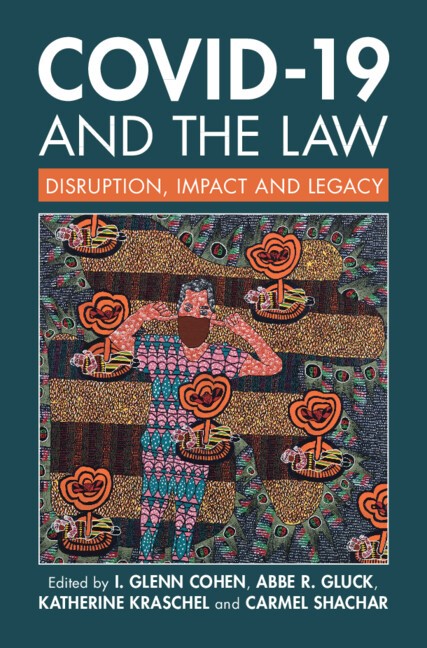
On November 9th, the eagerly awaited book titled “COVID-19 and the Law: Disruption, Impact, and Legacy” was released. Among the noteworthy chapters within this publication is one co-authored by the Professor Laura Hoffman, titled “Telehealth Transformation in COVID-19.” The chapter explores the significant impact of telehealth during the COVID-19 pandemic and its transformative role in the healthcare sector.