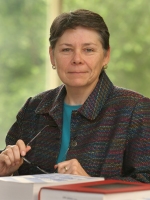
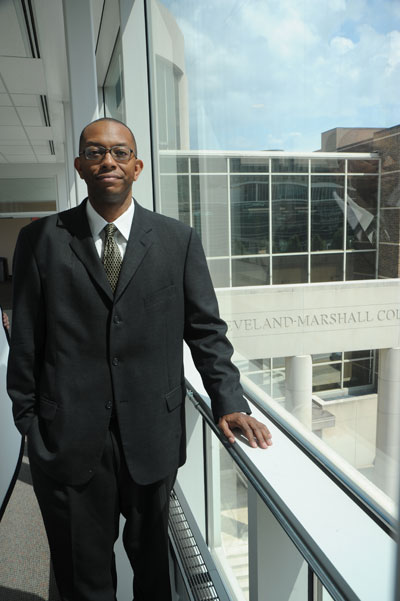
Professor Daiker-Middaugh Wins CMBA Award

daikermiddaugh219

This year, the Justice for All (JFA) Committee of the Cleveland Metropolitan Bar Association will present Professor Pamela Daiker-Middaugh with the JFA Volunteer of the Year Award.  The JFA Committee serves as the oversight committee to coordinate and support the CMBA’s pro bono and public service programs. It annually recognizes a volunteer for his/her outstanding service to the profession and community. Professor Daiker-Middaugh  is being recognized as this year’s JFA Volunteer of the Year Award, for her dedication as a volunteer for many of the CMBA’s pro bono and community programs, her leadership at the Bar, and for her invaluable assistance in encouraging volunteer service among law students and graduates.  The Award will be presented to Professor Daiker-Middaugh on Friday, June 13, at the Cleveland Metropolitan Bar Association’s seventh annual meeting and inaugural luncheon at the Cleveland Marriott Downtown at Key Center.

Plecnik Publishes Article on Three Reading Rule in The News-Herald

Professor John Plecnik published an article entitled “Three reading rule explanation” in The News-Herald.  The text of the article is available below.

Three-reading rule explanation

The three-reading rule requires legislation to be “read” or considered three times prior to a vote.  The U.S. Senate and House, Ohio General Assembly, and Ohio municipalities all embrace some version of the rule.  However, the rule is far older than Ohio or even the United States.

The Canadian Parliament, which also follows the rule, traces its source back to 15th and 16th century England, when it became the usual practice for the House of Commons.  However, multiple-reading rules are older still.  In the Reforms of 403 B.C., the Athenian Assembly adopted a two-reading rule, whereby each ordinance was read, then posted in the marketplace, and then read a second time prior to a vote.  Athens learned about the dangers of rash legislation the hard way.  In 406 B.C. during the Peloponnesian War, the Athenian generals failed to rescue their drowning sailors from the Spartan navy.  Over Socrates’s objection, the Athenian Assembly immediately voted to execute their generals.  Of course, without their generals, the Athenians soon lost the war.  Realizing their mistake, the Athenians adopted their two-reading rule.

Today, the three-reading rule is oft-criticized as inefficient.  In emergencies, most versions of the rule allow waiver by super-majority vote.  Critics waive the rule in most cases.  In fact, a survey by the Northeast Ohio Media Group shows that many Cleveland suburbs waive the rule nearly 90% of the time.  Before my election, Willoughby Hills also waived the rule in most cases.

Why object to waiver?  It might be more efficient to have a dictator, king, tyrant or mayor make all of our decisions.  But government is not a business and efficiency is secondary to fairness.  The three-reading rule is an ancient right of the people to a deliberative process and to participate in all the workings of their legislature.

According to Jeremy Bentham, the rule has five purposes:  “1. Maturity in the deliberations, arising from the opportunities given to a great number of persons, of speaking upon different days, after they have profited by the information which discussion has elicited; 2. Opportunity afforded to the public, to make itself heard—and to the members, to consult enlightened persons out of doors; 3. Prevention of the effects of eloquence, by which an orator might obtain votes upon a sudden impulse; 4. Protection to the minority of the assembly, by securing to it different periods at which to state its opinions; 5. Opportunity for members absent during the first debate, to attend when they perceive that their presence may influence the fate of the bill.”

But what of delay?  In true emergencies, the three-reading rule should be waived.  In all other cases, Bentham replies, “terrible decrees of urgency, the decrees for closing the discussion, may well be remembered with dread:  they were formed for the subjugation of the minority—for the purpose of stifling arguments . . . .” 

But why would your council wish to stifle argument? 

Sometimes, in the words of Professor Lawrence Keller of Cleveland State University, it is simply “sloppy government.”  Some councils are too lazy for three readings.  Sometimes, however, there is a more sinister reason.

In Willoughby Hills, our first major legislation of the year was passing appropriations for road and sewer projects.  Three council members, myself included, insisted on following the three-reading rule. In response, another council member claimed the service superintendant told him—absent immediate action—a dangerous sinkhole could develop on SOM Center Road.  By the third reading, we learned there was no immediate danger of a sink hole.  Worse still, we learned that the same member who warned of a sinkhole voted on similar appropriations for years that were ultimately paid to a company named Landco.  Public records show that Landco was not only the member’s employer, but owned by his parents.  Had council voted immediately, in all likelihood, more city money would have been paid to Landco before these revelations.

Some may say things have changed since the dawn the democracy, and modern technology obviates the need for three readings.  But the internet is no substitute for deliberation or confronting your council members face-to-face.  The three-reading rule has stood the test of time for good reason.
Professor Lewis Presents at Health Law Conference at UC Hastings

Leon and Gloria Plevin Professor of Law and Director of the Center for Health Law and Policy, Browne Lewis, participated in a panel discussion at the 37th Annual Health Law Professors Conference at the University of California Hastings College of Law in San Francisco, California, on June 6, 2014. Professor Lewis participated on the panel with three other Robert Wood Johnson Foundation Scholars in Residence.  She described her experience as a Scholar in Residence working with the Cleveland Public Health Department (CPHD) to address the public health issue of small cigar smoking among minors. 
 
According to Professor Lewis, the number of young people smoking cigarettes has declined.  However, the number of middle school and high school students smoking small cigars has increased by 124%.  Professor Lewis’ project at the CPHD focused upon the laws that could be put in place to discourage young people from smoking small cigars.  Her recommendations included passing resolutions that ban the sale of small cigars containing flavored tobacco, prohibit the sale of small cigars in packs of less than twenty, and require point-of-sale warnings about the dangers of tobacco use.  Professor Lewis also proposed that the CPHD take steps to education parents and children about the negative health consequences of smoking small cigars.

Sterio Participates in Radio Show “Talking Foreign Policy”

The Charles R. Emrick Jr. – Calfee Halter & Griswold Professor of Law and Associate Dean for Faculty Enrichment, Milena Sterio, participated in the “Talking Foreign Policy” radio show on WCPN 90.3 on June 5. Professor Sterio has been a regular participant in this quarterly radio show, hosted by Interim Dean and Professor Michael Scharf of Case Western Reserve University School of Law, and dedicated to the discussion of current foreign policy issues.  This episode, entitled “Russian Roulette: Ripples from Ukraine,” focused on the crisis in Ukraine and the American-Russian relations as this crisis unfolds.  Other participants included Professor Paul Williams of American University Washington College of Law, and Dr. Shannon French, Director of Case Western’s Inamori Center for Ethics and Excellence.  This episode will be broadcast on WCPN 90.3 on Tuesday, June 10, at 9:00 p.m.

Professor Kalir Presents at the Association of American Law Schools’ Midyear Meeting

Clinical Professor of Law Doron Kalir presented on Friday, June 6, at the AALS Workshop on Sexual Orientation and Gender Issues, part of the 2014 Midyear Meeting in Washington, D.C. Professor Kalir presented his work-in-progress article, “Same-Sex Marriage & Jewish Law: Time for a New Paradigm?” Audience members included colleague Professor Matthew Green, as well as professors from Columbia, NYU, and Indiana Law Schools.   

Professor Ray Presents at Law and Society Annual Meeting

Joseph C. Hostetler-Baker & Hostetler Professor of Law Brian Ray presented several draft chapters from his forthcoming book, Social Rights, South Africa and the Promise of Engagement (forthcoming with Cambridge University Press) at the June 2014 Law & Society Association meeting in Minneapolis, Minnesota.  Professor Ray also chaired a panel on differing approaches to judicial interpretation at the same conference.

Professor Lewis Publishes New Article

Aside

Leon and Gloria Plevin Professor of Law Browne Lewis published a new article, Due Date: Enforcing Surrogacy Promises in the Best Interest of the Child, 87 St. John’s L. Rev. 899.  In the article, Professor Lewis argues that the courts should apply contract principles and not family law principles to resolve surrogacy disputes.  Since children are unique, Professor Lewis argues, courts should presume that the contract should be specifically enforced.  As a result, the intended mother should be adjudicated the legal mother.  However, Professor Lewis further argues that the surrogate should be able to present evidence of changed circumstances to rebut the presumption of specific performance and permit the court to determine maternity based upon the best interests of the child.  Congratulations to Professor Lewis on this new publication.

Sterio Speaks on Syria at Law and Society Annual Meeting

Professor Milena Sterio spoke on the legality of unilateral humanitarian intervention in the context of Syria, at the Law and Society Annual Meeting in Minneapolis, Minnesota, on May 29.  The title of Professor Sterio’s remarks was: “The (Il)legality of Unilateral Humanitarian Intervention in Syria.”  Professor Sterio’s argument was that unilateral humanitarian intervention in internal conflicts, such as the one in Syria, should be “legalized” under a carefully developed normative framework.  Professor Sterio will be publishing a version of this paper with the Brooklyn Journal of International Law later this year.  

Davis Speaks to Travel Writers on Copyright and Fair Use

On May 3, 2014, C|M|LAW Professor Michael Davis spoke at the Society of American Travel Writers annual conference at the Cleveland Convention Center. The title of his presentation was “Copyright and Fair Use.” The discussion centered on the internet. Writers and editors who participated in the discussion expressed confusion regarding whether posted pictures or text are free when taking them from the internet, or whether aggregators have a right to aggregate material found there. In addition, the question was raised whether editors could freely take from the internet as well. Professor Davis explained that the answer to almost all the questions was no: legally, all those copies are copyrighted.  With very few exceptions, and depending upon how much material they took, the context of the taking, the nature of the work, and effect on the original author’s potential market, material might or might not be available for fair use.

Becker and Green Speak on LGBT Rights in Ohio

On May 16, 2014, C|M|LAW Professors Susan Becker and Matthew Green spoke at a free CLE program entitled “A Legal Overview of LGBT Rights in Ohio.”  This program was presented in conjunction with a free legal clinic set up to assist members of the lesbian, gay, bi-sexual or transgendered (“LGBT”) community with issues such as discrimination, name changes, family law, and immigration. It was sponsored by the Cleveland Metropolitan Bar Association, Equality Ohio, the Spanish-American Committee, the Legal Aid Society of Cleveland, and Nueva Luz Urban Resource Center.

Professor Susan J. Becker

Professor Susan J. Becker

Professor Becker spoke on the status of same-sex marriage, gave a brief overview of the history of the issue from the 1971 Baker v. Nelson case in Minnesota through the Windsor v. U.S. case decided by the U.S. Supreme Court last summer. Most of her talk focused on the significant changes to federal law (Social Security, taxes, Medicare, Family Leave Act, etc.) since Windsor which extend benefits to same-sex marriage couples.  She also focused on the status of the 49 cases now pending in federal courts that will likely lead to a U.S. Supreme Court decision on the constitutionality of states denying marriage to same sex couples. Finally, she spoke about the status of the law in Ohio for LGBT families.


Professor Matthew Green

Professor Matthew Green

Professor Green explained that despite decades of repeated attempts, Congress has yet to enact federal legislation to ensure equality in employment for LGBT employees. Although protections under some state and local laws exist, a significant number of LGBT workers are without legal protection.  Despite these truths, the legal landscape is complex and warrants study, considering LGBT workers face stubbornly persistent and widespread workplace discrimination.  To that end, it is imperative that LGBT workers, allies and advocates understand the current legal landscape as well as potential hurdles to protection.  Despite the dearth of legislation directly protecting LGBT workers, courts have used stereotyping theory and changing understandings of the concept of “gender” to protect LGBT workers under extant discrimination law.  Moreover, the U.S. Supreme Court’s recent, plaintiff-friendly retaliation decisions may further serve as a vehicle in some instances to protect LGBT workers from discrimination, albeit indirectly.  In addition to this complex legal landscape, emerging issues with respect to religion and the workplace may well present new challenges for LGBT workers in their quest for equality in employment.