Prof. Robertson Shares Expertise on Ohio’s Energy Development Laws

Professor Heid Gorovitz Robertson was interviewed by the Energy News Network and quoted in an article regarding Ohio’s legislative and regulatory approaches to oil gas development as compared with its approach to renewable energy development.  You may find the resulting article here:

Robertson is the Steven W. Percy Distinguished Professor of Law at CSU|Law and Professor of Environmental Studies at the Levin College of Public Affairs and Education at Cleveland State University.

Prof. Sterio Participates on Global Conflicts Panel

Professor Milena Sterio participated in the Centre for the Study of United Nations – O.P. Jindal Global University conference on “Confronting Global Conflicts and the Rule of Law: A Focus on Russia-Ukraine and Israel-Hamas” on May 3; Professor Sterio’s panel was on the specific topic of “Focus on Actions and Challenges in the Russia-Ukraine and Israel-Hamas Conflicts, and Discussion on Proposed Reforms.”

Prof. Brian Ray Leads Fireside Chat With Tech Journalist Stacey Higginbotham on “Why we need a new social contract for connected devices”

Prof. Brian Ray lead a conversation with national technology journalist Stacey Higginbotham on the ways connected devices and systems fail, and how those failures should inform new business models, laws and regulations, and even etiquette. Stacey has been covering technology topics for twenty years, most prominently on her long-running podcast and newsletter “Stacey on IoT” and more recently as an adviser to Consumer Reports on technology policy.

Professor Ray Co-Drafts U.S. Biometric Systems Privacy Primer with the Sedona Conference

Brian Ray, Leon M. & Gloria Plevin Professor of Law and Associate Dean for Faculty Development and Online Programs, chaired the drafting group for the Sedona Conference’s U.S. Biometric Systems Privacy Primer (“Primer“) (download here). Recently published for public comment, the Primer provides a general introduction to biometric systems and a summary of existing U.S. laws regulating the collection, use, and sharing of the biometric information these technologies collect.

The Primer is written as a resource for lawyers, judges, legislators, and other policymakers. It provides a general guide to the relationships among the technical, legal, and policy aspects of biometric systems – with a particular focus on privacy and related concerns these systems may raise.

Prof. Ray Discusses Senate AI Hearings on NPR LAist Air Talk

Leon M. and Gloria Plevin Professor of Law Brian Ray joined the NPR program LAist’s AirTalk to discuss recent U.S. Senate hearings on artificial intelligence (AI) with Sarah Myers Westmanaging director of AI Now Institute. Here’s the show description:

Some of the biggest names in tech have been flooding Capitol Hill this week as several Congressional meetings are taking place to outline comprehensive AI regulation and policy. The main event, held Wednesday, was a closed-door meeting between all 100 senators and tech giants including Elon Musk, CEO of Twitter (now rebranded as X), Mark Zuckerburg, co-founder of facebook, Bill Gates, co-founder Microsoft, and Sam Altman, CEO of the ChatGPT company OpenAI. The forum is part of an effort by a bipartisan group of senators, led by Senate Majority Leader Chuck Schumer, to create AI legislation. However, the forum has received criticism from others in the tech and media space for not being open to the public and seemingly prioritizing the opinions of tech companies over researchers, employees and activists. Among the CEOs invited to speak were also civil society members such as AFL-CIO President Liz Shuler and Leadership Conference on Civil and Human Rights President and CEO Maya Wiley. Senators Richard Blumenthal of Connecticut and Josh Hawley of Missouri also recently introduced a framework for the US AI Act calling for more transparency in training data and registration requirements for AI companies. So, what exactly is Congress hoping to get out of these discussions? And what kind of AI regulation can we expect in the near future?
Professor Witmer-Rich Interviewed by WCPN on Using DNA in Cold-Case Investigations

On August 16 WCPN interviewed Joseph C. Hostetler—Baker Hostetler Professor of Law Jonathan Witmer-Rich for a story on how DNA can help move cold-case investigations forward and bring closure for victims’ families.

Professor Kalir Interviews on Whether Mr. Trump Could Pardon Himself


In recent weeks, a discussion arose over whether – should he be re-elected for President – Mr. Trump would be able to pardon himself. Professor Kalir was interviewed by Verifythis.com on this issue. He explained, together with others, that while a President may pardon himself for any federal crime, he certainly could not do so with regards to state-charged crimes. The authority to pardon those is entrusted to the State Governors. Accordingly, it may well be that the New York State case – considered by many to be the least consequential of the three (or four) indictments – would prove the hardest obstacle to a re-elected President Trump, if that would be the case.  

Prof. Ray Leads EU AI Act Grand Challenge Team

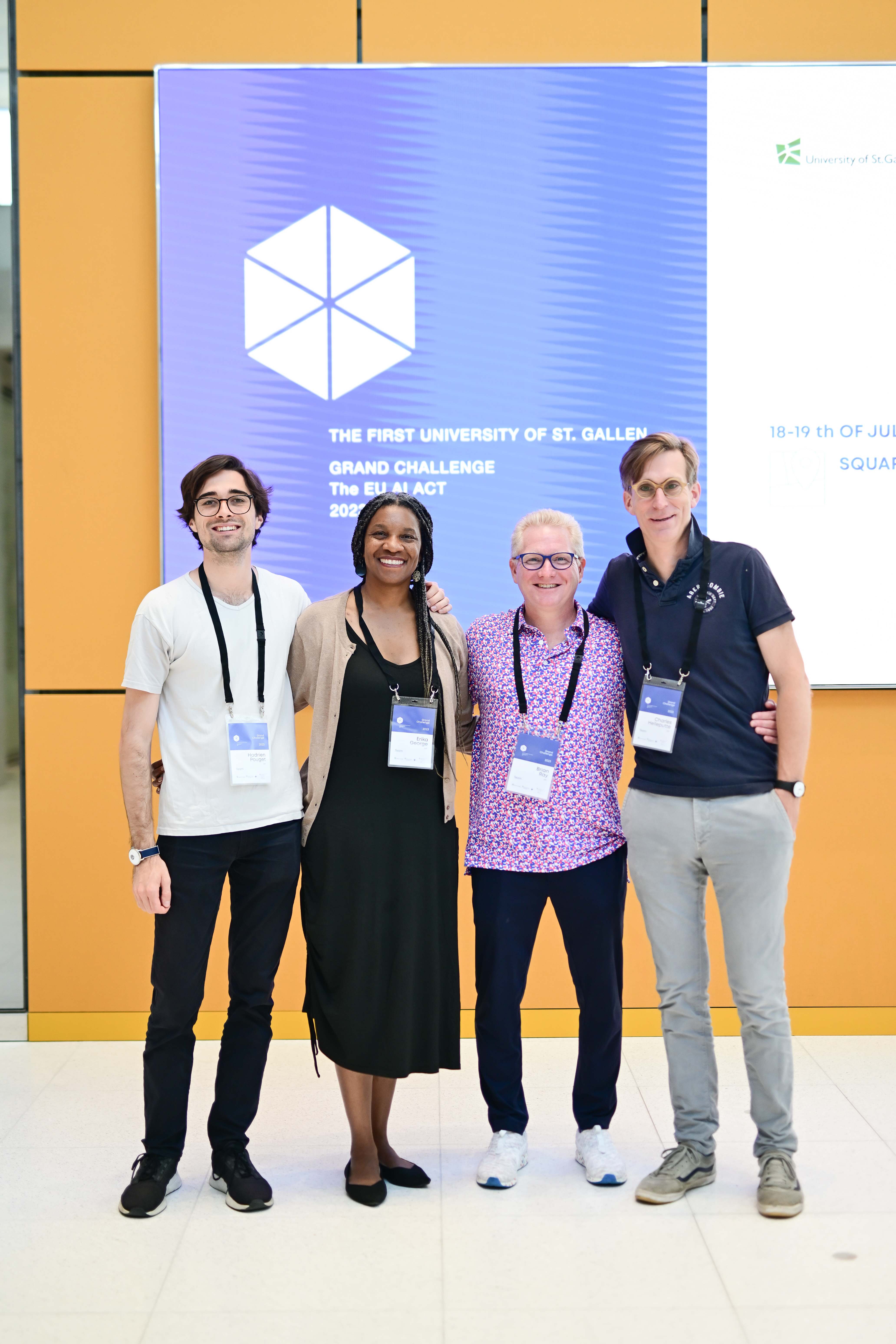
Professor Brian Ray led an interdisciplinary team of AI experts at the first annual EU AI Act Grand Challenge hosted by St. Gallen University in July 2022. Ray’s team — AI in the Public Interest or AIPI — included Erman Ayday (CWRU Engineering), Erika George (Utah Law), Anisa Halimi (IBM Ireland), Charles Helleputte (Squire Sanders France/Belgium) and Hadrien Pouget (Carnegie Endowment). AIPI was one of 12 teams selected internationally to compete in the two-stage competition to assess multiple AI systems for compliance with the draft European Union AI Act. In Stage 1, the teams evaluated three robotic systems that incorporated AI autonomy and mobility systems as part of the ARCHE Robotics Conference. In Stage 2, the teams evaluated three additional AI systems across two days at the University of St. Gallen Square.

Legal Educator in Residence Katz Presents at SEALS

Legal Educator in Residence Howard E. Katz made three presentations at the Southeast Association of Law Schools (SEALS) Annual Conference in Boca Raton, Fl, held from July 22 through July 29. He spoke about Designing an Effective Core Law School Course, as part of the Newer Law Professors Workshop. Howard also participated in a discussion group on Teaching Torts, and a discussion group on Making Sense of Teaching Evaluations and Faculty-Student Interaction.

Legal Educator in Residence Katz Presents at Leading Edge

Legal Educator in Residence Howard E. Katz made two presentations at the Ninth Annual Aspen Publishing Leading Edge Conference, held at the MIT Endicott House in Dedham, Massachusetts on July 10-12. The invitation-only conference brought together thirty-two thought leaders to discuss topics relevant to the future of legal education. Howard led two discussions. One session was on “(re)Designing the Curriculum (Especially the First Year) to Accomplish More/Other Things (and to Create Opportunity for Different Students to Thrive.” The other session, which Howard led along with Dean Michael Barry of South Texas School of Law, addressed the preparation students have or don’t have when entering law school, and ways of helping students, once they are admitted and enrolled, who do not have access to the unwritten rules of how to do law school.